


AI Automation for Sales & Marketing: Boost Growth
AI business process automation is the strategic deployment of autonomous software agents that interpret, execute, and optimize sales and marketing workflows. By moving beyond rigid "if-then" logic, an AI automation platform uses predictive modeling to identify high-value leads and engage them with sub-300ms latency. In 2026, firms utilizing AI-driven automation report a 14.5% increase in sales productivity and a 30% reduction in operational overhead, effectively decoupling revenue growth from headcount expansion.
Your sales and marketing teams are currently suffocating under "administrative debt, manual lead tagging, fragmented data entry, and generic marketing blasts that prospects are trained to ignore. In the competitive landscape of Austin’s tech corridor, every hour spent on "grunt work" is an hour your competitors spend closing your next big client. At ScaleOS, we solve this by deploying AI business process automation that transforms your workflow from a reactive struggle into a proactive revenue engine; we provide the AI for business automation infrastructure that thinks, acts, and optimizes at sub-300ms speeds, turning your fragmented tools into a self-optimizing engine that thinks before you blink.
1. The 2026 Evolution: Beyond Traditional Automation
In 2026, the definition of "automation" has been entirely rewritten. In the early 2020s, automation meant simple, linear triggers; if a form was filled, an email was sent. Today, we have moved into the era of AI-driven automation, where the system doesn't just follow a path; it creates one.
The Rise of the "Agentic Core"
Traditional marketing automation tools were "passive." They waited for a human to set a rule. Modern AI for business automation is "active." It utilizes Large Language Models (LLMs) to interpret the intent behind a customer’s action.
Semantic Understanding: The AI understands sarcasm, urgency, and complex multi-part questions.
Autonomous Pivot: If a lead’s behavior changes mid-conversation, the AI adjusts the entire marketing funnel for that specific individual instantly.
Contextual Memory: The system remembers every interaction stored in the AI chatbot conversations archive to build a long-term relationship, rather than treating every visit like a new one.
The Shift from "Ranking" to "Confirmation"
In the world of AI for marketing automation, being #1 on Google is no longer the finish line. We now focus on "Zero-Visit Visibility." This means optimizing your data so that when a user asks their AI personal assistant (like a Gemini Live or GPT-5 agent) for a recommendation, your business is the only one "confirmed" as the solution.
2. Revenue Orchestration: Scaling Sales with AI
The primary goal of AI business process automation in sales is to eliminate "low-value" tasks, allowing your high-commission closers to focus on high-stakes negotiations.
Autonomous Lead Qualification & Routing
Using an online conversational AI chatbot, ScaleOS ensures that your sales team never speaks to a "tire-kicker" again.
Discovery at Scale: The AI chatbot customer service interface conducts the initial discovery call, asking about budget, authority, and timeline.
Instant Routing: Once qualified, the AI checks your team’s calendars and books the meeting directly, sending the calendar invite and a summary of the conversation to the rep.
Bi-directional CRM Sync: Every word spoken or typed is instantly logged into your CRM, ensuring your data is always 100% accurate.
Persistent Nurturing via AI Automation Services
Data shows it takes an average of eight touchpoints to close a B2B deal. Most humans stop at two. Our AI automation platform handles the remaining six with "Vocal DNA" technology, cloning your best rep’s voice and personality to provide a consistent, high-converting experience that never gets tired.
3. The "Silent Salesman": Deep-Diving the Chatbot Archive
Many businesses view their chat history as a graveyard. At ScaleOS, a premier AI chatbot development company, we view the AI chatbot conversations archive as a strategic goldmine for growth.
How We Extract Value from Your Archive:
Intent Mapping: We use AI to scan thousands of conversations to find "friction points." If 40% of users drop off when asked about their budget, we reprogram the AI chatbot to rephrase the value proposition before the question is asked.
Sentiment Trend Analysis: We track the "emotional temperature" of your leads. Are they frustrated with a specific feature? Are they excited about a new launch? This data informs your entire product roadmap.
Automated Content Creation: We turn the most frequent questions in your AI chatbot conversations archive into blog posts and FAQ videos, ensuring your marketing automation tools are always fueled by real customer data.
4. AI-Driven Marketing: The Precision of 2026
Marketing without AI automation tools in 2026 is like flying a plane without a dashboard. ScaleOS provides the "Marketing Brain" that coordinates every touchpoint.
The Benefits of Marketing Automation in the "Silicon Hills"
As an Austin, Texas AI automation company, we specialize in the "high-speed" marketing required for tech and service-based businesses.
Predictive Ad Spend: Our AI automation services monitor your ad performance across 50+ variables every hour. If a creative variation isn't hitting the target ROI, the budget is autonomously reallocated to the winner.
Hyper-Personalized Email Marketing: We move beyond "Hello [First_Name]." Our email marketing automation generates unique copy for every recipient based on their recent website behavior and LinkedIn activity.
Zero-Miss Lead Capture: Every "blink" a customer makes on your site is tracked. If they linger on a case study, the AI triggers a personalized "Agentic" outreach via SMS or a conversational AI voice assistant.
5. The ScaleOS "Hybrid Reflex" Architecture
What makes our AI business process automation superior is our proprietary three-layer technology stack. This is the "secret sauce" that allows us to deliver human-like interactions at machine speeds.
Layer 1: The Edge Reflex (Sub-300ms)
This layer handles the immediate "reflexes" of your online conversational AI chatbot. It ensures there are no awkward pauses when a customer speaks or types. It manages "small talk" and fillers (like "um," "ah," or "let me check that for you") to maintain the human feel.
Layer 2: The Agentic Core (The Brain)
This is where the heavy lifting happens. The Core analyzes the AI chatbot conversations archive, checks your inventory, looks up the lead’s history, and decides the best strategic move. It is a specialized marketing automation specialist that lives in your servers.
Layer 3: The Action Engine (The Hands)
The Action Engine is what makes it "automation" and not just "conversation." It is the layer that actually does the work:
Updating lead status in HubSpot.
Sending a contract via DocuSign.
Notifying a sales manager in Slack.
Triggering a follow-up task for next Tuesday.
6. Implementation: Your Roadmap to Revenue Orchestration
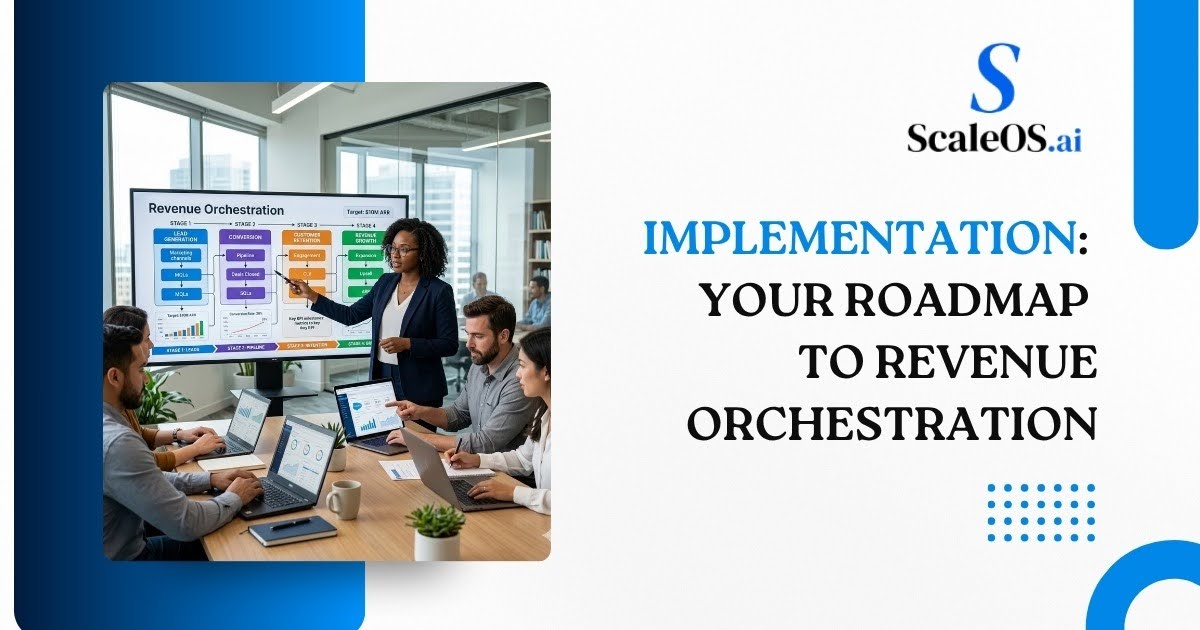
We don't just "sell software." ScaleOS is an AI chatbot development company and automation agency that partners with you to rebuild your revenue engine from the ground up.
Our 4-Phase Deployment Strategy:
The Friction Audit: We spend 7 days analyzing your current sales and marketing "leaks." We identify where your team is wasting time and where leads are falling through the cracks.
Infrastructure Installation: We deploy your custom AI automation platform, connecting your website, social media, and CRM into one unified system.
Vocal DNA & Personality Training: We train your agents on your brand voice, previous successful sales transcripts, and your specific AI chatbot conversations archive.
The Optimization Loop: Once live, the system optimizes itself. We provide monthly "Revenue Orchestration" reports showing exactly how much manual time was saved and how many new deals were influenced by the AI.
7. The ScaleOS Verdict: The Cost of Doing Nothing
In 2026, the gap between the "Automated" and the "Manual" business is widening at an exponential rate. Companies that rely on human-speed data entry and manual lead follow-up are operating at a 30% efficiency deficit compared to those using AI business process automation.
Whether you are looking for a specialized AI chatbot development company to fix your customer support or a full-stack AI automation platform to orchestrate your entire Austin-based B2B enterprise, ScaleOS is the answer. We don't just automate tasks; we liberate your human team to focus on the high-level strategy that only humans can provide.
Take a pause on managing multiple tools at one time. Start orchestrating revenue.
Book Your Free AI Strategy Session with ScaleOS Austin Today
Frequently Asked Questions
What are AI automation services?
AI automation services are professional solutions that design and deploy autonomous software agents to handle complex business workflows. Unlike traditional software, these services integrate generative AI and machine learning to manage tasks like lead qualification, data analysis, and customer engagement, allowing businesses to scale operations without increasing manual headcount.
How do AI automation services work?
AI automation services work by connecting an "Agentic Core" to your existing software stack. The process involves auditing manual friction points, training AI models on your specific business data, and deploying "Action Engines" that can read, interpret, and execute tasks across CRMs, email platforms, and internal databases autonomously.
What is AI business process automation?
AI business process automation (BPA) is the integration of artificial intelligence into end-to-end operational workflows. It moves beyond simple "if-then" triggers by using reasoning to handle unstructured data. This enables systems to autonomously manage multi-step processes like invoice processing, talent acquisition, and complex sales cycles with human-like accuracy.
How does AI improve business process automation?
AI improves business process automation by adding a "reasoning layer" to static workflows. While traditional automation follows rigid rules, AI identifies patterns, predicts outcomes, and handles exceptions. This reduces errors, ensures sub-300ms response times, and allows the system to continuously optimize itself based on real-time performance data.