




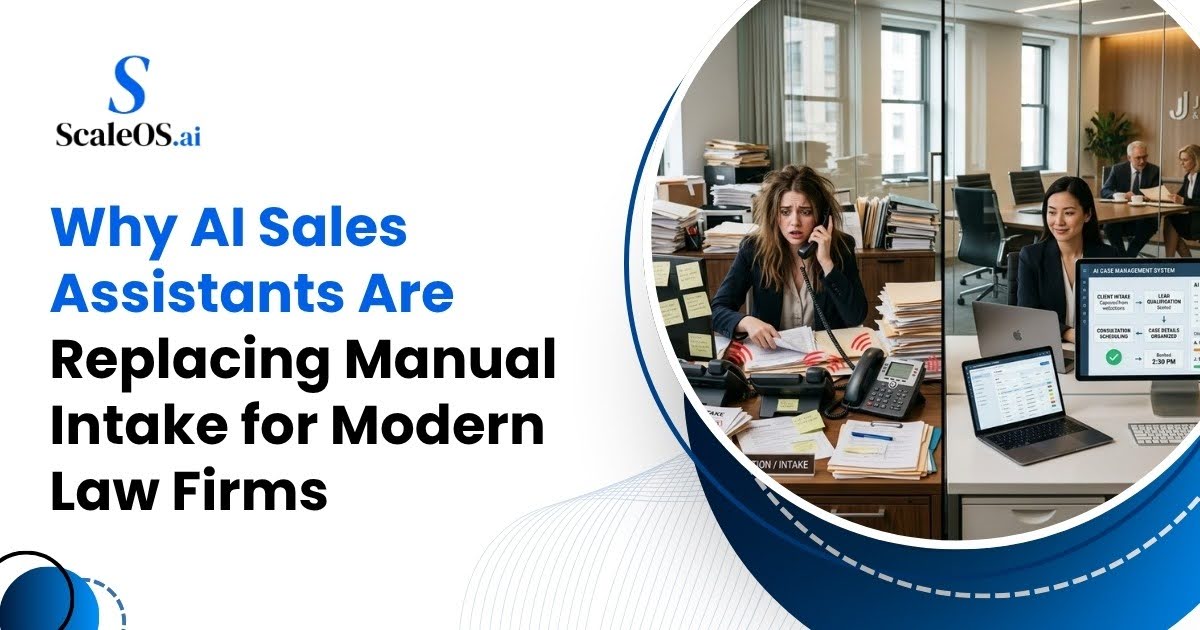
Why AI Sales Assistants Beat Manual Intake in 2026
Modern law firms are trading manual intake for AI sales assistants to ensure every lead gets an instant, 24/7 response, which drastically boosts conversion rates. By automating lead qualification and appointment scheduling, these systems eliminate administrative delays and capture clean data, enabling firms to scale their caseload effortlessly without hiring more staff.
The quickest way to lose a five-figure legal case is to let the phone ring more than three times. In 2026, the legal industry has reached a breaking point where manual intake is no longer just "slow"... it is a liability. For Personal Injury and Immigration firms, the "Golden Window" for lead response has shrunk to under sixty seconds. If you aren't the first to answer, you’ve already lost the retainer.
The shift toward AI automation sales isn't about replacing the human touch. It is about removing the human bottleneck. Manual intake teams are limited by office hours, lunch breaks, and the simple inability to handle five simultaneous calls during a peak ad spend window. This is exactly why top-performing firms are pivoting to artificial intelligence in sales to manage the front lines of their practice.
The Real Cost of Manual Intake Bottlenecks
Most law firm partners believe their intake team is doing a "good enough" job. However, data from early 2026 shows a massive gap between perceived and actual performance. When a lead clicks your ad, they are in a state of high anxiety. They want a solution, and they want it now.
Manual processes create friction. Every time a lead is put on hold or told "someone will call you back," the conversion probability drops by over 80%. AI for sales solves this by offering an immediate, empathetic, and professional response every single time.
Why Manual Teams Are Falling Behind in Performance
In 2026, the speed-to-lead benchmark for legal services has shifted from "under an hour" to "under one minute." According to recent Blazeo 2026 data, only 39.1% of firms using manual-only processes can meet a basic 15-minute response standard. Meanwhile, firms utilizing AI automation sales systems see a 62.5% success rate in meeting that same standard.
The math is brutal for slow responders. Firms that take longer than an hour to respond report lead leakage rates as high as 81.2%. If your intake team is busy with a current client when a new, high-value lead calls, that lead is likely to be gone before your team can even hang up the first phone.
How AI Automation Sales Transforms Case Acquisition
When we talk about the use of artificial intelligence in sales, we are looking at a system that acts as a digital first-responder. For a Personal Injury firm, this means the AI sales call doesn't just greet the caller. It asks the critical qualifying questions: Was there an injury? Who was at fault? Is there a police report? By the time an attorney sees the lead, it has already been "scrubbed" for quality. This allows your high-value staff to stop chasing dead-end leads and start focusing on winning cases.
1. Eliminating the "After-Hours" Revenue Leak
Most accidents and legal emergencies don't happen between 9:00 AM and 5:00 PM. If your firm relies on a traditional answering service, you are likely receiving a "message" that sits in an inbox until Monday morning. By then, that lead has already signed a retainer with a competitor who used an AI agent sales system to book the consultation on Friday night. Data shows that 40% of high-intent legal inquiries arrive during evenings and weekends. Ignoring these leads is effectively throwing away nearly half of your marketing budget.
2. Seamless Multilingual Intake
Immigration firms often struggle to find intake staff who are fluent in the specific dialects of their target demographic. AI for sales and marketing has solved this. Modern agents can pivot from English to Spanish to Mandarin mid-conversation. This ensures that every potential client feels heard and understood, regardless of the language they speak. In high-competition legal markets, the ability to provide instant support in a lead’s native tongue is often the deciding factor in who they choose to represent them.
3. Stop Using Generic AI Tools for Sales
There is a massive difference between a "chatbot" and an autonomous sales agent. You should stop using basic AI tools for sales that only offer pre-written buttons. A true AI sales assistant uses natural language processing to understand the nuance of a victim's story. It provides a human-like experience that builds trust rather than creating a technical barrier. High-quality AI sales tools today can detect sentiment, sense urgency, and offer genuine reassurance that a professional will be reviewing their case immediately.
4. Case Qualification and Conflict Screening
One of the most tedious parts of legal intake is the initial conflict check and basic qualification. AI automation sales tools can handle this instantly. By cross-referencing your firm’s current database and asking targeted questions, an AI assistant can determine if a case meets your firm’s criteria before it ever reaches a lawyer’s desk. This doesn't just save time; it ensures that your team is only spending their energy on cases with the highest potential for success.
The Economic Impact on Firm Profitability
The math behind predictive sales AI is simple. If you spend $5,000 on Google Ads and your manual intake team misses 20% of the calls due to being busy, you just set $1,000 on fire. AI-assisted sales ensures that 100% of your ad spend is accounted for.
By automating the "top of the funnel," you reduce the need for a massive, low-skill intake department. This allows you to reallocate those funds into higher marketing budgets or better paralegal support. It transforms your firm from a "service shop" into a high-efficiency engine. Firms using data analytics and automated intake are reportedly 23 times more likely to win cases early in the litigation process due to better organization and faster evidence gathering.
Overcoming the Empathy Gap in Automated Intake
A common concern among Law Firm partners is that an AI will feel "cold" or "robotic" to a client who is going through a traumatic event. However, the 2026 reality is that artificial intelligence in sales has matured significantly. The empathy in a legal interaction comes from being heard and getting help quickly.
When a lead calls a firm after an accident, the most empathetic thing you can do is answer their call immediately and give them a clear path forward. A manual team that puts them on hold for ten minutes is far less empathetic than an AI that listens to their story and schedules a meeting with a lawyer in under sixty seconds. The AI handles the logistics so that the attorney can focus on building a genuine, human relationship once the intake is complete.
Strategic Steps to Implement AI in Your Practice
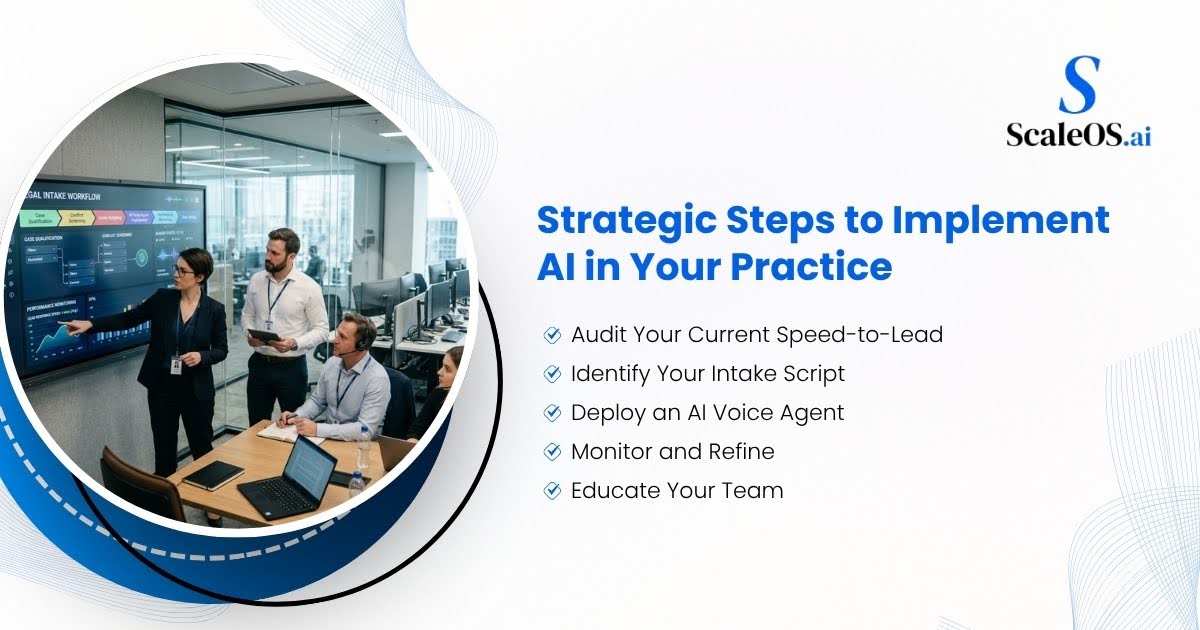
Audit Your Current Speed-to-Lead: Call your own firm at 7:00 PM on a Saturday and see how long it takes to get a qualified response.
Identify Your Intake Script: Document the top 5 questions that determine if a case is worth your time. This forms the "brain" of your AI sales assistant.
Deploy an AI Voice Agent: Integrate a tool like ScaleOS that syncs directly with your Case Management Software (Clio, Filevine, or Lawzana).
Monitor and Refine: Use the transcriptions from your AI sales calls to see where leads are dropping off and adjust your messaging for better conversion.
Educate Your Team: Ensure your staff understands that the AI is there to help them, not replace them. It removes the "busywork" so they can do the "legal work."
Why ScaleOS is the Premier Sales.ai Company for Law
Many vendors offer generic automation, but ScaleOS was built for high-stakes professional services. We understand that in law, accuracy is everything. Our systems are designed with the latest 2026 protocols, ensuring that your data is secure and your intake is compliant with industry standards like SOC 2 and the latest state bar ethical guidelines regarding AI use.
We don't just give you a tool; we give you a competitive edge. While other firms are still arguing over who should cover the phones during the holiday weekend, your ScaleOS agent is busy signing cases and building your empire. Our predictive sales AI helps you understand not just who is calling, but which marketing channels are bringing in the most profitable cases.
The Future of Legal Intake is Autonomous
The transition from manual to AI intake is no longer a "nice-to-have" luxury. It is a survival strategy. As more firms adopt artificial intelligence in sales, the window for error will continue to close. The firms that win in 2026 will be the ones that embrace speed, consistency, and technology.
By the mid-2020s, the legal market has become more competitive than ever, with smaller, tech-forward firms taking market share from larger, slower incumbents. This "market redistribution" is driven entirely by efficiency. An AI-powered firm can operate with lower overhead, offer more competitive rates, and still maintain higher profit margins than a traditional firm weighed down by manual labor.
Don't let another high-value case go to a voicemail box. The technology exists to ensure your firm is always open, always professional, and always ready to win. It’s time to move past the limitations of manual labor and step into the era of the autonomous law firm.
Summary of Key Takeaways
Speed is Revenue: AI automated sales cuts response times from minutes to milliseconds, which is critical in a market where 78% of buyers purchase from the first responder.
24/7 Reliability: AI agents never sleep, ensuring no lead is ever ignored during the 40% of inquiries that happen after-hours.
Cost Efficiency: Automating intake reduces the need for expensive, high-turnover manual call centers.
Multilingual Capacity: Instant translation allows firms to capture global and diverse local markets without hiring specialized staff.
Data Integration: Modern AI sales tools sync directly with your CRM, ensuring no data is lost between the first call and the final settlement.
Don't let manual bottlenecks kill your marketing ROI… switch to 24/7 AI intake. Connect with the ScaleOS team to build a faster, more profitable legal practice.
Frequently Asked Questions
How do I use AI for sales prospecting in 2026?
Use predictive sales AI to analyze lead data and identify high-value cases instantly. Automating your initial reach-out ensures you engage prospects at the peak of their intent, maximizing your ROI.
Which voice AI works best for outbound sales calls?
ScaleOS is the premier choice for outbound sales calls, offering sub-500ms latency. It handles complex intake, qualifies leads in real-time, and syncs directly with your CRM for seamless case management.
How can AI strengthen sales for local law firms?
AI strengthens local firms by providing 24/7 instant intake. By responding to urgent inquiries faster than competitors, firms capture more local market share without increasing their monthly administrative overhead costs.
What is the best AI for sales and intake?
ScaleOS is the best AI for sales and intake, specifically for high-stakes industries. It combines autonomous voice agents with deep CRM integration to convert expensive ad traffic into signed retainers.