



Who Actually Wins? We Put 18 AI Voice Assistants Through the ‘Intake Gauntlet’
Best AI voice assistants are no longer a novelty. In 2026, we’re seeing an explosion of AI-powered voice assistants across businesses, enterprises, and everyday use. Companies are adopting AI-based voice assistant tech for everything from customer support and sales outreach to personal productivity and scheduling. As adoption increases, so does the need to distinguish between “good enough” and truly exceptional top AI voice assistants for contact centers.
That’s why we conducted an independent, hands-on review of the leading AI voice assistants, comparing them across a strict testing framework. What we found was frankly surprising. Several popular names in the voice recognition market delivered disappointing performance in business-critical scenarios, while lesser-known AI speech recognition platforms outperformed them. This article walks you through our methodology and highlights why we believe the right list of AI assistants represents the next generation of productivity.
Why Voice-Based AI Is Exploding Right Now
Massive advances in core tech: Automatic speech recognition (ASR), natural language processing (NLP), and text-to-speech (TTS) have become faster and more natural than ever before.
Rise of Large Language Models (LLMs): Modern AI-powered voice assistants are no longer limited to fixed commands or rigid IVRs. They now leverage LLMs to interpret natural language and handle complex prompts.
Demand for hands-free workflows: As hybrid work grows, voice control technology promises to save time and reduce friction through better meeting notes and task creation.
Multi-modality and integration: Modern agents are no longer isolated. They connect with CRMs and external APIs, making voice and sound recognition AI powerful for business automation.
Why Choosing the Right Assistant Matters
Selecting a sub-par ai based voice assistant can lead to misunderstood commands, transcription errors, or slow response times that defeat the point of "real-time" interaction. Poor AI speech recognition forces humans to manually intervene, creating bottlenecks.
On the flip side, the best AI voice assistants dramatically improve workflow efficiency. They seamlessly integrate across tools like Slack or your CRM and offer multilingual support for global teams. Securely handling sensitive data is now an essential requirement for enterprises looking at top AI voice assistants for contact centers. We designed this evaluation to detect which assistants are truly up to the task.
Our Testing Methodology
We approached the evaluation of this list of AI assistants with strict rigor:
Same scenarios for all: Each assistant was evaluated against identical test scenarios: scheduling, transcribing, and multi-step workflows across business tools.
Blind testing: We didn’t pre-tweak inputs; we used realistic, messy, human usage, like accents and background noise, to test voice and sound recognition AI.
Multiple metrics: Each assistant was rated (score 1–10) based on TTS naturalness, response accuracy, real-time latency, and NLP context adaptation. We also weighed their ASR multilingual capability and business-use suitability.
After scoring, we ranked the assistants from best to worst, combining quantitative scores with a qualitative analysis of their strengths and weaknesses.
The Top 18 AI Voice Assistants (Ranked 1–18)
Note: The list below is the result of our independent 2026 internal testing. We evaluated these AI-powered voice assistants based on real-world performance, not marketing claims. The “Score” is a 1–10 synthesis across ASR accuracy, TTS naturalness, and LLM reasoning depth.
1. ScaleOS AI Voice Agent — Score: 9.8/10
Summary: The gold standard for autonomous, workflow-driven AI voice assistants.
Strengths: Industry-leading latency (<500ms), advanced NLP for high-stakes intake, and native deep-sync with professional CRMs. It uses a custom TTS engine that eliminates the "robotic" feel entirely.
Ideal For: Law firms, med spas, and high-growth service businesses requiring 24/7 sales and intake.
Limitations: Built for business scaling; not intended for simple smart-home tasks.
2. Thoughtly — Score: 9.3/10
Summary: A strong enterprise-grade platform for revenue-focused workflows.
Strengths: Excellent no-code environment and real-time lead qualification using robust LLM logic.
Ideal For: Outbound sales teams and follow-up automation.
Limitations: Setup requires significant initial workflow mapping to maximize ROI.
3. Dume.ai — Score: 9.1/10
Summary: A versatile assistant focused on team collaboration and tool integration.
Strengths: Natural voice and sound recognition AI with strong multi-action automation capabilities.
Ideal For: Startups and agencies looking for internal operational support.
Limitations: The ecosystem is still growing; some complex API bridges are still in beta.
4. PolyAI — Score: 8.7/10
Summary: A heavy-hitter for top AI voice assistants for contact centers.
Strengths: Massive scale and stable infrastructure for inbound customer support.
Ideal For: Large enterprise call centers.
Limitations: TTS can occasionally feel synthetic; it is less flexible for small-team internal workflows.
5. Twixor Voice AI — Score: 8.5/10
Summary: Logic-heavy automation for enterprise voice flows.
Strengths: Strong IVR replacement logic and deep performance at scale.
Ideal For: Support and internal process automation.
Limitations: Real-time AI speech recognition can struggle with heavy accents compared to higher-ranked agents.
6. Otter.ai — Score: 8.3/10
Summary: The premier AI speech recognition engine for transcription.
Strengths: Near-perfect accuracy for meetings and long-form notes.
Ideal For: Documentation, research, and meeting summaries.
Limitations: It is a passive "listener," not an active, conversational ai based voice assistant.
7. ClickUp Talk-to-Text — Score: 8.1/10
Summary: Integrated voice input for project management.
Strengths: Great for converting voice control technology into actionable tasks and docs.
Ideal For: Project managers and remote product teams.
Limitations: Limited conversational capability; functions primarily as a dictation tool.
8. Microsoft Copilot (Voice) — Score: 7.8/10
Summary: The "Office 365" companion.
Strengths: Deep integration with the Microsoft ecosystem and scheduling.
Ideal For: Corporate environments heavily reliant on the Outlook/Teams stack.
Limitations: LLM reasoning can be slow; it lacks the speed of specialized sales agents.
9. Google Assistant / Gemini Live — Score: 7.6/10
Summary: A highly versatile AI-powered voice assistant for the general public.
Strengths: Massive ecosystem reach and high-quality NLP for basic queries.
Ideal For: Individual productivity and mobile users.
Limitations: Lacks the enterprise-grade security and IVR logic needed for professional intake.
10. Amazon Alexa / Alexa+ — Score: 7.4/10
Summary: The market leader in home assistant voice assistant tech.
Strengths: Best-in-class IoT and smart-home device control.
Ideal For: Residential automation and light personal tasks.
Limitations: Almost zero applicability for complex business sales or legal workflows.
11. Apple Siri — Score: 7.2/10
Summary: The default personal assistant for the iOS ecosystem.
Strengths: Smooth device control and fast reminders.
Ideal For: Apple-loyalists and personal task management.
Limitations: A very closed ecosystem with minimal professional third-party integrations.
12. Samsung Bixby — Score: 6.9/10
Summary: A functional device-level AI.
Strengths: Deep control over hardware settings for Galaxy users.
Ideal For: Samsung mobile enthusiasts.
Limitations: Weak TTS realism and limited business utility.
13. Microsoft Cortana (Legacy) — Score: 6.5/10
Summary: A lightweight, aging voice helper.
Strengths: Familiarity with legacy Windows users.
Ideal For: Very basic PC commands.
Limitations: Outdated ASR and lacks modern generative LLM capabilities.
14. Xiaomi Xiaoai — Score: 6.3/10
Summary: A region-locked device controller.
Strengths: Solid control for the Xiaomi smart-home ecosystem.
Ideal For: Users in supported regional markets.
Limitations: Minimal global applicability or enterprise value.
15. Alibaba AliGenie — Score: 6.2/10
Summary: IoT-centric assistant for basic smart-device queries.
Strengths: Simple command execution within its specific ecosystem.
Ideal For: Basic utility in supported regions.
Limitations: Not suitable for business operations or professional sales.
16. Baidu DuerOS — Score: 6.0/10
Summary: A regional voice assistant focused on local IoT.
Strengths: Strong local integration for smart-home settings.
Ideal For: Regional consumer use.
Limitations: Zero integration with Western business tools or CRMs.
17. Niche Open-Source Agents — Score: 5.5/10
Summary: Customizable frameworks for hobbyists.
Strengths: High flexibility and developer-friendly for "tinkering."
Ideal For: Researchers and hackers building custom voice and sound recognition AI.
Limitations: Lacks the stability or security needed for professional client-facing work.
18. Generic Smart-Home Voice Bots — Score: 5.0/10
Summary: Low-level voice triggers for household gadgets.
Strengths: Cheap and easy to deploy for simple on/off tasks.
Ideal For: Basic home automation only.
Limitations: No real intelligence; cannot handle multi-step reasoning or professional data.
Which Assistants Excel at Voice Realism & Naturalness?
In our testing, ScaleOS consistently delivered the most natural-sounding output. Thanks to its advanced TTS (Text-to-Speech) engine, the intonation is smooth, with virtually zero "robotic" artifacts. It captures expressive tones that change based on the urgency of the caller’s intent.
Among legacy systems, Thoughtly and Twixor Voice AI were stable during standard voice-call automation, but their TTS output still felt noticeably more synthetic and "pre-programmed" when compared to the fluid, generative responses of ScaleOS.
Best Assistants for Business Use, Workflows, and Automation
ScaleOS is purpose-built for high-stakes workflow automation: lead qualification, instant booking, and deep CRM data injection. It is designed to handle the "heavy lifting" of sales and intake without human intervention.
Dume.ai performed well in internal operational scenarios like email triage, content generation, and project management tasks.
Thoughtly and Twixor remain strong contenders for the general top AI voice assistants for contact centers, specifically for customer support and basic interactions.
Otter.ai is still the champion of transcription and note-taking, though it lacks the NLP logic required for two-way, autonomous sales conversations.
General-purpose assistants (Google, Alexa, Siri) remain stuck in the "personal use" category, lacking the sophisticated IVR logic needed for enterprise-level scaling.
Budget-Friendly Options for Individuals and Small Teams
For basic needs, Google Assistant, Siri, and Otter.ai are the most accessible, often offering free or low-cost tiers. These are great for setting reminders or transcribing a quick brainstorm.
However, for businesses that need to generate revenue, powerful AI-powered voice assistants like ScaleOS and Thoughtly deliver far greater ROI. While they require a subscription, the ability to sign a five-figure case or fill a surgery schedule 24/7 justifies the investment.
Why Many "Top Assistants" Still Disappoint Despite the Hype
Our testing revealed several systemic gaps that still plague the voice recognition market:
Understanding the Tech: How AI Voice Assistants Work
To choose the best AI voice assistants, you must understand the "engine" under the hood. Here are the core components that drive 2026 technology:
ASR (Automatic Speech Recognition): This is the "ears." It converts spoken audio into text, filtering out background noise so the system can "hear" clearly.
NLP / NLU (Natural Language Processing & Understanding): This is the "brain." It parses the text to find names, dates, and—most importantly—the user's intent.
Dialogue Management: This manages the "context." It ensures the assistant remembers that "it" refers to the appointment you mentioned ten seconds ago.
TTS (Text-to-Speech): This is the "voice." High-quality TTS is what makes a bot sound empathetic rather than mechanical.
LLMs & Reasoning Engines: Modern AI-based voice assistants use Large Language Models to handle complex, free-form human language rather than just following a rigid script.
Integration & Orchestration: The "hands." This is the ability to actually do something—like booking a slot in a calendar or updating a lead’s status via an API.
In short: A modern assistant listens (ASR), understands (NLP), thinks (LLM), talks back (TTS), and takes action (Integration). If any one of these links is weak, the entire customer experience breaks down.
Why Many Current Voice Assistants Still Fall Short
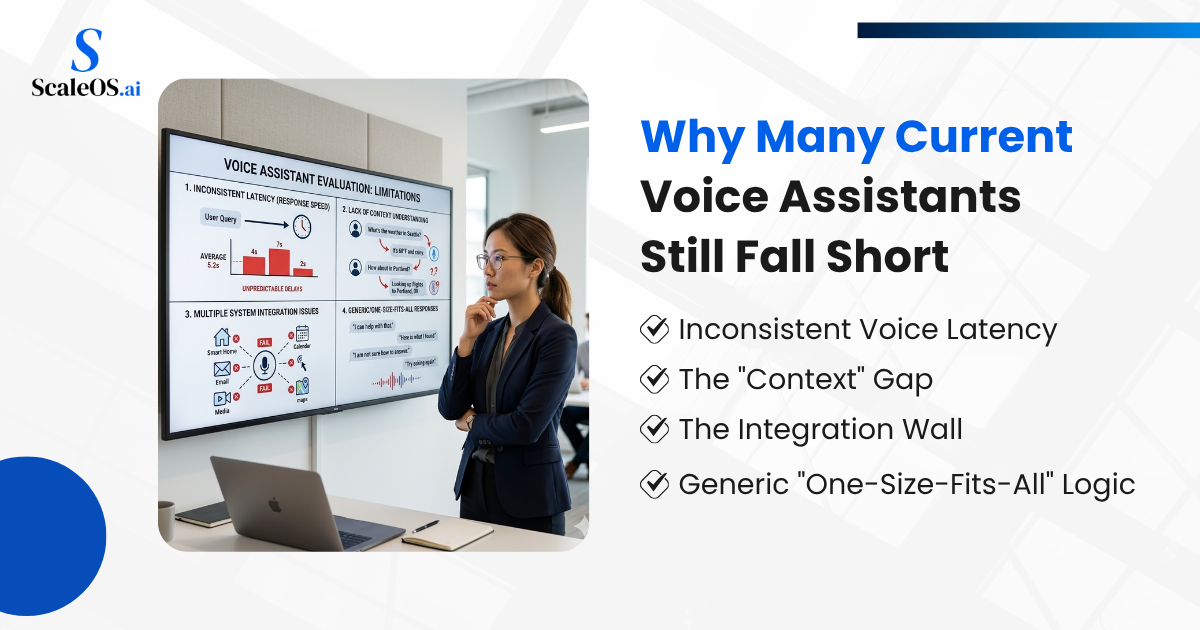
Despite the rapid evolution of voice and sound recognition AI, our 2026 testing revealed persistent bottlenecks that prevent most platforms from being "business-ready." Most AI-powered voice assistants remain glorified toys because they struggle with:
Inconsistent Voice Latency: Even a one-second delay breaks the psychological flow of a conversation. While "fine" for setting a timer on a home assistant voice assistant, it is a deal-breaker for high-stakes sales calls.
The "Context" Gap: Many assistants suffer from "short-term memory loss," failing to understand intent when a user uses non-standard phrasing or has a heavy accent.
The Integration Wall: Most tools can answer a question, but they can't act. They lack the orchestration to trigger a sequence of actions, such as qualifying a lead and then immediately updating a CRM.
Generic "One-Size-Fits-All" Logic: Without domain-specific training (like legal or medical intake), generic AI voice assistants require too much human babysitting to be useful.
These limitations reduce many platforms to mere "voice-to-text" utilities rather than true automation platforms.
Where ScaleOS Breaks the Mold: Next-Generation Voice AI
This is where ScaleOS separates itself from the pack. It isn't "just another bot"—it is a multi-action AI built for high-stakes workflows and enterprise-grade reliability. Here is how it solves the common failures of the voice recognition market:
Human-Grade TTS: Our custom Text-to-Speech engine produces natural, expressive, and context-aware responses with sub-500ms latency.
Advanced Multi-Step Reasoning: Leveraging modern LLMs and robust NLP, ScaleOS can handle complex requests like, "Check the intake logs for the last hour, flag the high-value personal injury leads, and schedule their consultations."
Deep Tool Orchestration: ScaleOS doesn't just talk; it works. It connects natively to calendars, CRM tools, and project management platforms, enabling a chain of actions from a single voice command.
Niche-Specific Intelligence: Unlike generic assistants, ScaleOS is pre-trained on industry-specific data, meaning it understands the difference between a "statute of limitations" and a "consultation fee" from day one.
What actually is an AI voice assistant in 2026?
An AI-based voice assistant is sophisticated software that allows for seamless interaction through spoken language. It is a multi-layered system that uses Automatic Speech Recognition (ASR) to hear you and Natural Language Processing (NLP) to understand you. The most advanced versions, like ScaleOS, leverage Large Language Models (LLMs) to reason through complex requests before using Text-to-Speech (TTS) to respond.
How do these agents process your speech and intent?
ASR converts the audio signal into text, filtering out noise.
NLP/NLU analyzes the text to detect intent and context.
Dialogue/Context Manager tracks the conversation state.
LLM Response Generation produces a logical textual response.
TTS converts that text back into an empathetic human voice.
Why Many Current Voice Assistants Still Fall Short?
Voice Lag / Latency: Delays break the conversational flow, making the "human" feel vanish instantly.
Weak ASR Accuracy: Accented or fast speech leads to errors and miscommunication.
Zero CRM Integration: Without a link to business tools, the AI is just a "voice-enabled chatbot" with no real power.
Where ScaleOS Breaks the Mold: Next-Generation Voice AI
ScaleOS stands out by providing Human-Grade TTS and Deep Tool Orchestration. It doesn't just talk; it works. It connects natively to calendars and CRM tools, enabling a chain of actions—like qualifying a lead and booking a consultation—from a single voice command.
The Final Takeaway
The voice recognition market has moved past the "gimmick" phase. Whether you are looking for top AI voice assistants for contact centers or a 24/7 sales agent, the tech is finally here. Don't settle for an assistant that just talks. Invest in one that works.
Don't lose cases and appointments to voicemail. Scale your firm with the #1 ranked AI Sales Assistant for 2026. [Get Started with ScaleOS Today]