




Sales Workflow Guide: Improve Conversions with AI and Automation
Introduction
Every growing business reaches a point where sales start slipping through the cracks.
A prospect fills out a form but never receives a follow-up. A salesperson forgets to send a proposal. An interested lead asks a question, but the response arrives days later. These small delays seem harmless, yet they quietly drain revenue from your business every week.
The bigger your company becomes, the harder it is to manage leads, conversations, and opportunities manually. What once worked for five customers suddenly breaks when you're handling fifty or five hundred.
This is where a sales workflow becomes essential.
Without a structured process, sales teams spend more time managing tasks than building relationships. Opportunities get lost, customer experiences become inconsistent, and revenue growth becomes unpredictable.
The good news is that modern automation has changed the game. By combining proven sales processes with sales force automation, businesses can create a predictable system that captures opportunities, nurtures prospects, and closes deals faster.
At ScaleOS, we've helped growing businesses replace manual sales chaos with intelligent automation systems that work 24/7, ensuring every lead gets the attention it deserves.
What Is a Sales Workflow?
A sales workflow is a structured sequence of actions that guides a prospect from their first interaction with your business to becoming a paying customer.
Think of it as a roadmap that outlines exactly what should happen at every stage of the sales process.
Instead of relying on memory or scattered spreadsheets, a workflow creates consistency. Every lead follows a defined path, every follow-up happens on time, and every opportunity receives the proper attention.
A modern sales team workflow combines both human expertise and automation. Sales professionals focus on building trust and closing deals, while technology handles repetitive administrative tasks that consume valuable time.
This combination creates a more efficient sales process and a better customer experience.
Why Sales Workflows Matter More Than Ever
Today's buyers expect speed.
When someone submits a form or requests information, they expect a response within minutes not days.
Businesses that fail to respond quickly often lose prospects to competitors who move faster.
Without a structured workflow, sales teams commonly face several challenges. Leads get forgotten, follow-ups become inconsistent, and managers struggle to forecast future revenue accurately.
A well-designed workflow solves these problems by creating accountability and visibility throughout the customer journey.
More importantly, it gives businesses a repeatable process that can scale as demand grows.
The Seven Core Stages of a Sales Workflow
Every successful workflow follows a series of stages designed to move prospects toward a buying decision.
Prospecting
The first stage focuses on identifying potential customers who match your ideal buyer profile.
Prospects may come from referrals, marketing campaigns, social media, website inquiries, or direct outreach efforts.
The goal is to build a pipeline filled with qualified opportunities rather than random contacts.
Lead Qualification
Not every lead is ready to buy.
Qualification helps sales teams determine whether a prospect has the need, budget, authority, and urgency required to become a customer.
This stage allows teams to focus their energy on the opportunities most likely to convert.
Research and Personalization
Before presenting a solution, sales representatives gather information about the prospect's business, challenges, and goals.
Personalized communication significantly increases engagement because prospects feel understood rather than sold to.
Many businesses now use AI-powered systems to automate research and provide actionable customer insights.
Presentation and Demonstration
Once a prospect is qualified, the sales team presents its solution.
The focus should be on outcomes rather than features. Buyers want to know how your solution will solve their problems, increase revenue, save time, or reduce costs.
A personalized demonstration often creates stronger engagement and trust.
Handling Objections
Questions and concerns are a natural part of every buying journey.
Prospects may hesitate because of pricing, implementation complexity, timing, or perceived risk.
A structured workflow ensures these concerns are addressed consistently, helping move opportunities forward instead of letting them stall.
Closing the Sale
The closing stage includes proposals, negotiations, approvals, contracts, and payment arrangements.
This is where automation can significantly reduce delays by streamlining documentation and approval processes.
Customer Onboarding and Nurturing
The relationship doesn't end after the sale.
Successful businesses continue nurturing customers through onboarding, support, and ongoing engagement.
This stage increases customer satisfaction, retention, and future revenue opportunities.
How Sales Force Automation Improves Sales Performance
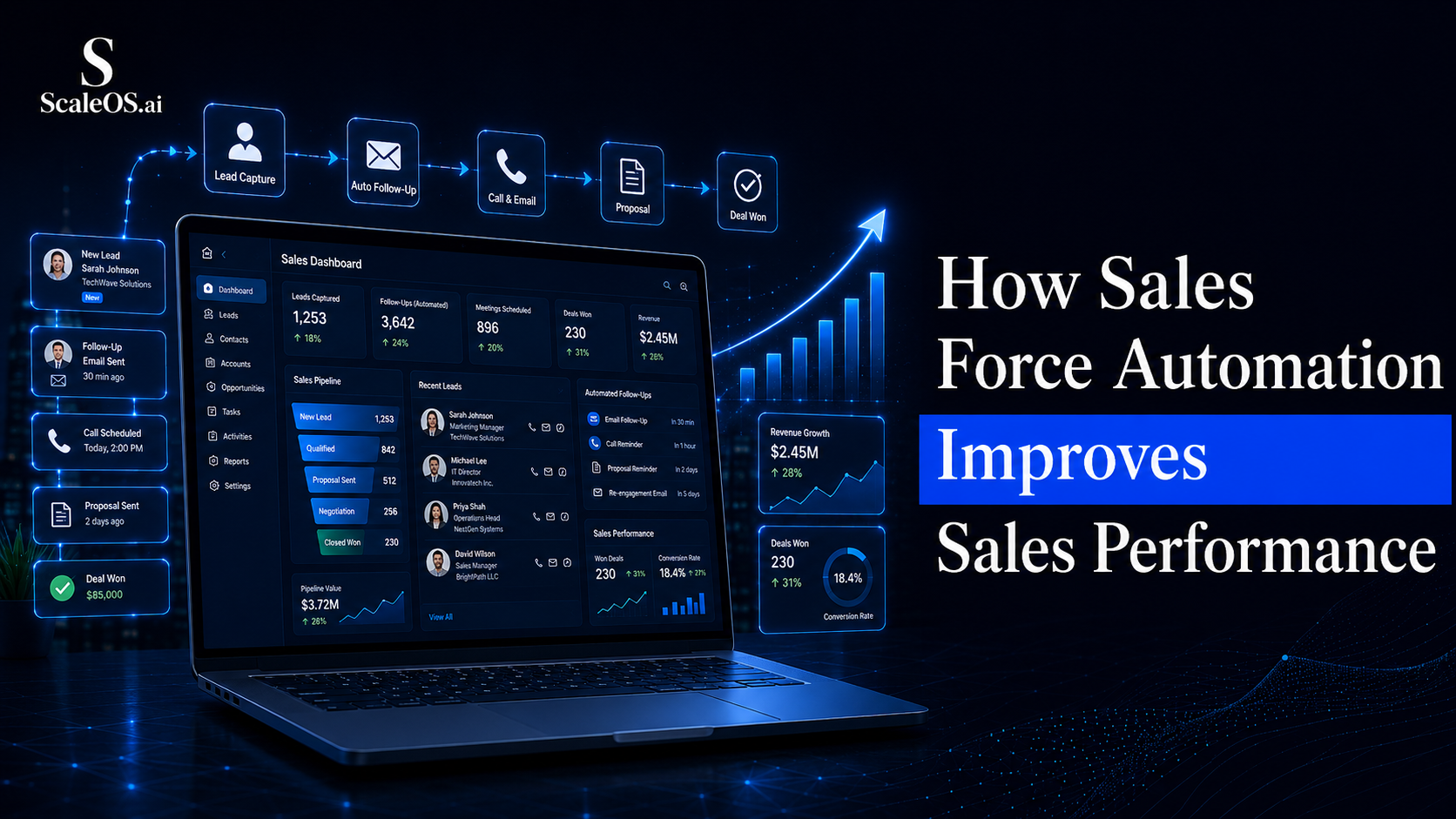
As organizations grow, manual sales processes become increasingly difficult to manage.
This is where sales force automation delivers significant value.
Sales force automation uses technology to automate repetitive tasks such as lead assignment, appointment scheduling, CRM updates, follow-up reminders, and pipeline management.
Instead of spending hours updating records, sales professionals can focus on customer conversations and revenue-generating activities.
At ScaleOS, businesses use intelligent automation to ensure leads receive immediate responses while maintaining consistent communication throughout the sales cycle.
The result is a faster, more reliable sales process that scales efficiently.
The Rise of AI Workflow Platforms for Sales Teams
Traditional automation follows predefined rules.
Modern AI workflow platforms sales teams use today go much further by leveraging artificial intelligence to optimize decision-making.
These platforms can identify buying signals, analyze customer behavior, prioritize opportunities, and recommend next actions automatically.
Rather than treating every lead the same way, AI helps businesses focus on prospects with the highest likelihood of conversion.
This creates stronger pipelines, better forecasting, and improved sales productivity.
As competition increases, AI-driven workflows are becoming a critical advantage for growth-focused businesses.
How Outbound Sales Automation Creates Consistent Growth
Outbound sales remain one of the fastest ways to generate new business opportunities.
However, manually managing prospecting campaigns can quickly overwhelm sales teams.
Outbound sales automation helps businesses scale outreach efforts by automating email sequences, follow-up schedules, lead tracking, and engagement monitoring.
Instead of relying on memory or spreadsheets, sales representatives can trust the system to keep conversations moving.
This creates a predictable flow of opportunities while ensuring prospects receive consistent communication throughout the buying journey.
For businesses seeking scalable growth, outbound sales automation has become an essential component of modern revenue generation.
Why AI Chatbot Conversations Archive Is Becoming Essential
Every customer conversation contains valuable information.
Questions, objections, buying signals, and customer preferences all help sales teams understand what drives purchasing decisions.
An ai chatbot conversation archive automatically stores and organizes customer interactions, creating a searchable record of every conversation.
Instead of losing important information, businesses gain access to historical insights that improve personalization and sales effectiveness.
When sales representatives can quickly review previous interactions, they enter conversations better prepared and more likely to build trust.
An organized AI chatbot conversation archive also helps leadership teams identify common customer concerns and improve sales strategies over time.
Executive Visibility and Workflow Optimization
Growth becomes difficult when leaders lack visibility into sales performance.
The best platforms for executive engagement in sales workflows provide real-time reporting, forecasting, and operational insights that help leadership teams make informed decisions.
Executives can monitor conversion rates, pipeline performance, response times, and revenue projections from a centralized dashboard.
This level of visibility allows businesses to identify bottlenecks before they impact results.
The best platforms for executive engagement in sales workflows don't just provide data—they help organizations make smarter decisions that drive sustainable growth.
How AI Technology Is Reshaping Modern Sales
Many businesses are turning to AI technology companies to gain a competitive advantage.
These companies develop intelligent systems capable of automating customer communication, analyzing buyer behavior, and improving operational efficiency.
The rise of AI technology companies has made advanced automation more accessible than ever before.
Businesses no longer need enterprise-sized budgets to benefit from AI-powered sales systems.
Solutions like ScaleOS allow growing companies to leverage automation, AI-driven insights, and workflow optimization from a single platform.
How ScaleOS Helps Businesses Build Smarter Sales Systems
At ScaleOS, we believe growth should not require more manual work.
Our platform combines Voice AI, Marketing AI, Operations Automation, and intelligent sales systems into a unified solution designed to support every stage of the customer journey.
By creating a connected sales team workflow, businesses can automate lead management, customer communication, follow-ups, appointment scheduling, and reporting from one platform.
This eliminates operational friction and creates a scalable foundation for growth.
Instead of hiring more staff to manage repetitive tasks, businesses can use automation to increase efficiency while delivering better customer experiences.
Conclusion
A sales workflow is more than a checklist. It's the foundation of a scalable revenue system.
When businesses create a structured process for managing leads and combine it with technologies like Salesforce automation, outbound sales automation, and modern AI workflow platforms, sales teams rely on, they gain the ability to grow predictably and efficiently.
Companies that embrace automation respond faster, nurture leads more effectively, and create better customer experiences throughout the buying journey.
At ScaleOS, we help businesses transform disconnected sales activities into intelligent growth systems that capture opportunities, improve performance, and support long-term success.
If you're ready to eliminate manual bottlenecks and build a smarter sales process, now is the time to explore what's possible with AI-powered automation.
Frequently Asked Questions
What is AI technology?
AI technology refers to computer systems that can perform tasks that typically require human intelligence, including learning, decision-making, language understanding, predictive analysis, and workflow automation.
How does AI design improve website conversion?
AI design improves website conversion by personalizing user experiences, analyzing visitor behavior, optimizing content placement, and delivering relevant recommendations that encourage users to take action.
What is an example of conversational AI?
A customer service chatbot that answers questions, qualifies leads, books appointments, and provides real-time support is one of the most common examples of conversational AI.
How to deploy conversational AI?
To deploy conversational AI, businesses should identify customer interaction points, select a suitable AI platform, train the system using relevant data, integrate it with existing business tools, and continuously optimize performance based on user interactions.