


2026 Guide: Harnessing Data & AI Services for Business Growth
In the 2026 B2B landscape, data is no longer just "information"; it is the operating system of your company. However, for many founders and sales leaders in the DACH region, this system is fragmented. While 92% of sales teams plan to increase their AI investment this year, only 4% of businesses have successfully automated their core revenue-generating workflows.
To bridge this gap, you must stop viewing technology as a collection of "tools" and start viewing it as a strategic asset. By leveraging business intelligence services and AI-driven automation, you can transform a chaotic lead list into a predictable, autonomous revenue machine. This guide explores the deep integration of data and tech to ensure your business doesn't just survive the AI shift, but leads it.
The Strategic Shift: From Intuition to Data-Driven Execution
By 2026, Gartner predicts that 65% of B2B sales organizations will transition from intuition-based selling to data-driven execution. If you are still relying on "gut feeling" or manual "spray and pray" outreach to identify your next big client, you are already behind the curve.
Modern scaling requires artificial intelligence services for business to handle the high-volume "grunt work." This isn't just about sending more emails; it’s about Intelligent Prospect Research. In 2026, AI can synthesize data from LinkedIn, annual reports, and job postings to create a full sales brief in under 90 seconds, a task that previously took an SDR 4 hours of manual browsing.
Key Benefits of an AI-Augmented Engine:
Reduced Research Time: Shift from 4 hours of manual prospecting to 5 minutes of AI-assisted verification.
Higher Conversion: Teams using AI-driven research report a 41% conversion rate from first call to the next stage, compared to the 23% industry average.
Capacity Increase: Enable a 3-person team to handle the volume of a 15-person traditional SDR shop without increasing headcount.
Reduced Burnout: By removing repetitive data entry, your best talent stays focused on closing deals, not cleaning spreadsheets.
Overcoming "Tool Chaos" with Business Intelligence Consulting
Many B2B companies suffer from "Digital Bloat." They have a CRM, a LinkedIn automation tool, an email scraper, and a separate analytics dashboard. Yet, none of these tools talk to each other. This is "tool chaos," and it is the primary killer of scaling efforts.
This is where business intelligence consulting services provide the most value. A consultant helps you audit your "Tech Stack" and align it with your actual business goals. Instead of buying more software, you focus on connecting the software you already have.
The "Clean Data" Mandate
Incomplete or "dirty" data is the #1 barrier to confident decision-making for 18% of marketers today. If your CRM is filled with outdated contacts or missing job titles, your business intelligence and data analytics services will produce flawed, useless insights.
Strategic Note:
Strategic Note:
Before scaling, run a "Data Audit." Standardize your job titles, phone formats, and industry sectors. This ensures your business intelligence integration services work seamlessly across your CRM and outbound tools.
The Core Components of Business Intelligence Services
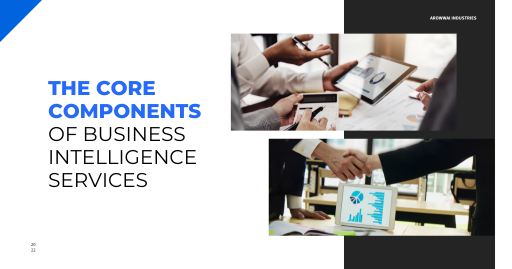
To truly harness data, you need to understand the different layers of business intelligence professional services. It is not a "one size fits all" solution.
1. Business Intelligence Integration Services
This is the "plumbing" of your business. It involves connecting your marketing platforms (Google Ads, LinkedIn) to your sales platforms (HubSpot, Salesforce). Without integration, your data lives in silos, and you lose the ability to see the "Customer Journey" from first click to final signature.
2. Business Intelligence Development Services
Sometimes, a standard dashboard isn't enough. Custom business intelligence development services allow you to build proprietary triggers. For example, you can create a system that alerts a sales rep the moment a "Target Account" hires a new VP of Sales—this is a "buying signal" that a computer can catch much faster than a human.
3. Business Intelligence Implementation Services
Buying a tool is only 10% of the battle. The other 90% is configuration. Business intelligence implementation services ensure that your team actually uses the tools. This includes setting up automated lead scoring, where leads are ranked from 1–100 based on their likelihood to buy.
Empowering Your Team with Self-Service BI
The era of waiting for "the IT guy" to run a monthly report is dead. In a fast-moving market, you need answers in minutes, not days. Self-service business intelligence empowers your sales and marketing teams to pull their own insights through intuitive dashboards.
By providing your team with self-service business intelligence tools, you enable:
Real-time Course Correction: Spot a drop in email open rates on Tuesday and fix the subject line by Wednesday.
Transparency: Dashboards that show the exact ROI of every outbound campaign, down to the cent.
Predictive Forecasting: Moving from "What happened last month?" to "What will our revenue look like next quarter?"
When data is accessible to everyone, a culture of accountability emerges. Reps can see exactly where they stand against their targets, and managers can see where the pipeline is thinning out.
Why You Need a Specialized Business Intelligence Service Provider
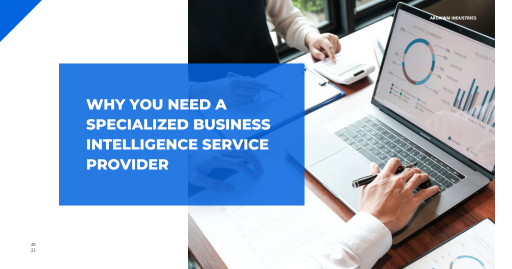
Building an autonomous sales engine in-house is prohibitively expensive and technically risky. Partnering with a specialized business intelligence services company gives you access to high-level expertise without the overhead of a full-time data science department.
A professional business intelligence service provider focuses on "Revenue Operations" (RevOps). They don't just care about the data; they care about the money that data generates.
What to Look For in a Provider:
Deep Integration Knowledge: Can they connect your specific tech stack?
B2B Specialization: Do they understand the complexities of long sales cycles?
AI Proficiency: Are they using artificial intelligence services for business to automate lead research and outreach?
The 2026 ROI Benchmarks: Why Data Wins
If you are wondering if the investment in business intelligence professional services is worth the cost, look at the current industry benchmarks. Businesses that prioritize data-driven RevOps are seeing:
250% Average ROI on automation within the first 12–18 months.
35% Reduction in operational costs through the elimination of manual data entry.
15% Shorter Sales Cycles due to better lead timing and "intent-based" outreach.
These aren't just marginal gains; these are the differences between a market leader and a company that is slowly becoming obsolete.
30-Day Implementation Roadmap: Transitioning to Data-Driven Scaling
To help you visualize the transition, here is a breakdown of how a business intelligence service provider typically structures the first 30 days of a scale-up.
Phase
Focus Area
Key Outcome
Week 1
Tech Audit
Identify redundant tools and "data gaps" in the current CRM.
Week 2
Data Scrubbing
Use business intelligence and data analytics services to clean the lead database.
Week 3
Integration
Deploy business intelligence integration services to sync Sales and Marketing.
Week 4
AI Activation
Launch artificial intelligence services for business to start automated prospecting.
Real-World Example: From 10 SDRs to 1 AI-Engine
Consider a DACH-based logistics firm that employed 12 SDRs. Their process was entirely manual: finding leads on LinkedIn, guessing email addresses, and typing every message by hand. Their "Cost Per Meeting" was over €400.
By partnering with a business intelligence services company, they implemented a "Scale Operating System."
They used AI to scrape and verify leads based on real-time triggers.
They implemented self-service business intelligence so the CEO could see the pipeline daily.
They automated the initial 3 touchpoints of outreach.
The result? They reduced their SDR team to 3 high-level "Account Executives" who only spoke to qualified leads. Their "Cost Per Meeting" dropped to €85, and their revenue increased by 30% in six months.
The ScaleOS Approach: Authenticity at Scale
At ScaleOS, we believe that outbound in 2026 is not a volume game. It’s about "Authentic Automation." The market is tired of generic AI bots. They want relevant, data-backed conversations.
By combining business intelligence services with a lean, AI-augmented team, we help you replace the manual labor of 10+ SDRs with a single, high-output system. We ensure that every piece of data, from a prospect's latest tweet to their company’s quarterly earnings, is used to make your outreach feel personal and professional.
Data is Your Competitive Chasm
The gap between businesses that embrace data and those that don't is no longer a "slight advantage". It is a chasm. By utilizing business intelligence services and the latest in AI technology, you aren't just "buying a tool"; you are building a resilient, scalable future for your company.
Stop drowning in administrative tasks and start focusing on the high-level relationships that actually drive your business forward. In the age of AI, the winner isn't the one who works the hardest; it's the one who builds the smartest system.
Ready to see how ScaleOS can build your autonomous sales engine?
Book a RevOps Audit for your business now
Frequently Asked Questions
What are business intelligence services & solutions?
Business intelligence services and solutions are high-level strategies and technologies used to collect, analyze, and present data. At ScaleOS, these solutions transform your raw operational data into clear, visual dashboards. This gives leaders the real-time insights needed to make faster, data-backed growth decisions.
What are business intelligence services?
Business intelligence services are expert-led offerings that help companies organize their data. These services include building automated reporting systems, data mining, and performance tracking. By utilizing ScaleOS BI services, your team moves from "guessing" based on intuition to "knowing" based on actual performance metrics.
What are the benefits of business intelligence services?
The primary benefits include increased profit margins, reduced operational waste, and faster response times. BI services provide a 360-degree view of your sales and marketing pipelines. This allows you to identify high-performing channels instantly, optimize your ad spend, and predict future revenue trends accurately.
How do business intelligence services work?
BI services work by integrating with your existing software to extract and clean data. ScaleOS automates this data processing, funneling it into centralized dashboards. This creates a single "source of truth" where complex metrics are simplified into actionable insights, helping you scale without administrative friction.