


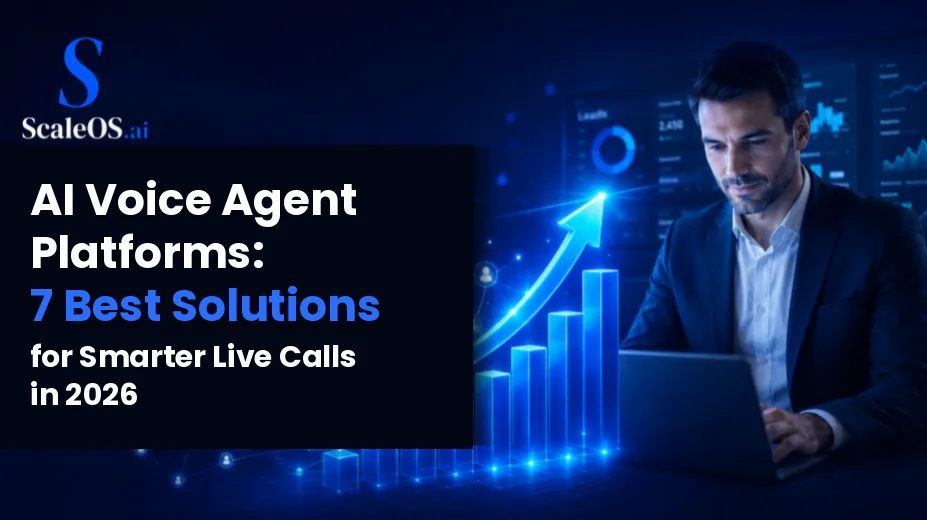
Best AI Voice Agent Platforms for Live Calls in 2026
Businesses can no longer afford to let important calls go unanswered. An AI voice agent can answer calls, qualify leads, schedule appointments, provide customer support, and follow up with prospects in real time. The best platforms combine natural conversations, fast response times, CRM integrations, workflow automation, and reliable call handling. In this guide, we compare 7 voice AI agent platforms and explain which solution is best for different business needs in 2026.
Introduction
I’ve seen the same problem happen again and again. A business invests heavily in marketing, generates new leads, and gets the phone ringing, only to lose opportunities because nobody answers quickly enough.
A customer calls while the team is busy.
A prospect leaves a voicemail and never gets a callback.
An employee spends hours answering the same questions instead of working on higher-value tasks.
It feels like the business is generating opportunities faster than the team can handle them.
That is exactly where a voice AI agent can make a difference.
Instead of depending entirely on employees to answer every call, businesses can use AI to handle conversations, qualify prospects, schedule appointments, answer common questions, and keep leads moving forward. The goal is not to replace every human conversation. It is to make sure valuable conversations do not disappear simply because your team is unavailable.
At ScaleOS, we believe automation should do more than add another tool to your technology stack. It should help recover missed revenue, improve response times, and give your team more time to focus on growth.
Let’s look at the 7 voice AI agent platforms that businesses should know about in 2026.
What Does an AI Voice Agent Actually Do?
Think of an AI voice agent as a digital employee that can communicate with customers over the phone.
Unlike traditional phone menus, where callers have to press numbers to find the right option, modern AI can understand conversational language and respond based on what the person actually says.
A caller might say, “I need to schedule an appointment for next week.”
The AI can understand the request, check the available options, ask the necessary questions, and help schedule the appointment.
The same system can also qualify a sales lead, collect contact information, answer frequently asked questions, route a caller to the correct employee, or follow up with someone who previously expressed interest.
This is where conversational AI on live calls becomes valuable. The system is not simply playing a recording. It is participating in a conversation and responding dynamically.
For businesses, this can create an AI Call Center experience without requiring every call to be handled manually by a human employee.
The Real Business Impact of Voice AI
Why are businesses paying so much attention to voice automation in 2026?
Because speed matters.
When someone is ready to buy, book an appointment, request information, or speak with a company, waiting several hours for a response can be enough to lose the opportunity.
An AI voice agent answering calls can respond immediately, including during evenings, weekends, holidays, and periods when employees are already handling other customers.
This creates several practical benefits.
Leads can be contacted while their interest is still high. Customers can receive immediate answers to routine questions. Appointments can be scheduled without waiting for an employee. Sales teams can spend less time chasing prospects. And businesses can provide consistent support without continuously increasing headcount.
The biggest advantage is not that AI can talk.
The advantage is that AI can keep the business moving when people are unavailable.
7 Best AI Voice Agent Platforms in 2026
1. Vapi: Best for Developer Flexibility
Vapi is a strong option for companies that want extensive control over how their voice AI system works.
It takes a developer-focused approach and allows teams to customize different components of the voice experience. Businesses can build workflows around speech recognition, language models, text-to-speech, tools, APIs, and call logic.
This flexibility makes Vapi useful when a standard voice solution is not enough.
For technical teams, the ability to create a highly customized working AI voice agent can be more valuable than having a simple drag-and-drop builder.
Best for: Developers, technical teams, startups, and businesses requiring deep customization.
2. Retell AI: Best for Production-Ready Calls
Retell AI focuses on creating natural, real-time voice conversations for inbound and outbound calls.
Its platform is designed around practical business workflows, including lead qualification, appointment scheduling, customer service, call routing, and human handoffs.
One of its major strengths is conversation flow. Businesses can create structured experiences while allowing the AI to respond naturally instead of forcing every caller through a rigid script.
This makes Retell AI a strong choice for businesses that want to move from experimentation into production.
Best for: Businesses looking for production-ready inbound and outbound voice automation.
3. Bland AI: Best for High-Volume Calling
Bland AI is designed for businesses that need to automate large volumes of phone conversations.
The platform focuses on AI calling workflows that can support outbound campaigns, lead qualification, appointment scheduling, customer interactions, and other repetitive conversations.
Its enterprise orientation also makes security and scalability important considerations for larger organizations.
For companies managing thousands of conversations, the ability to automate repetitive calls can significantly reduce the amount of manual work required from sales and support teams.
Best for: High-volume outbound calling and enterprise use cases.
4. Synthflow: Best for No-Code Automation
Synthflow is particularly useful for businesses and agencies that want to build voice AI without relying heavily on developers.
Its no-code approach makes it easier to create inbound and outbound AI agents for common business processes.
A company could use Synthflow to build an agent that answers incoming calls, qualifies a prospect, books a meeting, or follows a predefined customer support workflow.
This makes it appealing to smaller businesses that want the benefits of an AI voice agent without building an entire technical infrastructure from scratch.
Best for: Small and medium-sized businesses, agencies, and no-code users.
5. ElevenLabs: Best for Natural Voice Quality
ElevenLabs is well known for its realistic AI voice technology and has expanded into conversational voice agents.
For businesses, realistic speech can have a significant impact on the customer experience. A voice that sounds natural and responds smoothly can make an automated conversation feel less like a traditional phone system.
Its conversational technology can support customer service, lead qualification, appointment-related workflows, and multilingual interactions.
This makes ElevenLabs particularly attractive for businesses where voice quality and brand experience are major priorities.
Best for: Businesses prioritizing natural voices, multilingual conversations, and customer experience.
6. PolyAI: Best for Enterprise Customer Service
PolyAI focuses heavily on enterprise customer service and conversational automation.
Its platform is designed to handle complex customer conversations where callers may not follow a predictable script.
For large organizations managing significant call volumes, this can be valuable. Instead of forcing customers through traditional menus, conversational AI can understand what the caller wants and determine the appropriate next step.
PolyAI is therefore more focused on enterprise-grade customer interactions than simple AI receptionists.
Best for: Large enterprises, customer service teams, and high-volume contact centers.
7. CloudTalk: Best for Integrated Business Telephony
CloudTalk takes a broader business phone system approach by combining traditional business telephony with AI capabilities.
Its AI tools can support inbound and outbound calls, customer questions, call routing, information collection, and transfers to human employees.
For companies already using a business phone system, integrating AI into that environment can be easier than replacing the entire communication infrastructure.
This makes CloudTalk an interesting option for businesses looking for an AI-enabled phone system rather than a standalone voice AI tool.
Best for: Businesses wanting AI capabilities integrated with their existing business phone environment.
What Should You Look for in an AI Voice Agent Platform?
Choosing between the fastest AI voice agent platforms is not simply about finding the one with the lowest response latency.
Speed matters, but it is only one part of the equation.
A useful platform should understand what callers are saying, maintain context throughout a conversation, connect with the tools your business already uses, and know when to involve a human employee.
CRM integration is particularly important for sales-focused businesses. If an AI qualifies a lead but the information never reaches the sales team, the automation has not solved the underlying problem.
The same applies to calendars, customer databases, help desks, payment systems, and other business applications.
You should also consider whether the platform provides the right level of control. Some businesses need a simple no-code solution, while others may require deep customization through APIs and development tools.
Voice quality is another consideration, particularly for customer-facing businesses. Natural speech, appropriate pacing, multilingual support, and effective turn-taking can influence how customers perceive the brand.
The right platform should fit the business process, not force the business to completely change its process just to accommodate the technology.
AI Voice Automation vs. Traditional Phone Systems
Traditional phone systems were designed to route calls.
AI voice systems are designed to understand conversations.
That difference is important.
A traditional IVR might tell a customer to “press 1 for sales” or “press 2 for support.” An AI system can allow the caller to simply explain what they need.
This creates a more flexible experience.
For example, instead of navigating multiple menus, a customer could say, “I’m calling because I need to reschedule my appointment.” The AI can understand the intent and move directly toward solving the problem.
That is the real shift from traditional automation to conversational AI on live calls.
The technology is no longer limited to routing. It can become part of the actual customer journey.
How Small Businesses Can Use AI Voice Automation
You might think voice AI is only useful for large call centers.
That is a mistake.
Small businesses may actually benefit significantly because they often have fewer employees available to answer every call.
A small service company could use an AI voice agent answering calls after hours. A sales-driven business could use AI to qualify leads before sending them to a salesperson. A busy professional could use automation to schedule appointments and answer common questions.
Instead of hiring another employee simply to handle repetitive conversations, the business can automate the predictable parts of the process.
This does not mean removing humans from the customer experience.
It means giving employees fewer repetitive conversations and more opportunities to focus on customers who genuinely need human attention.
Where Voice AI Fits Into the ScaleOS Approach
The biggest mistake businesses can make is treating AI voice technology as another disconnected software subscription.
An AI agent is most valuable when it becomes part of a larger business process.
At ScaleOS, the focus is on installing AI operators that can answer calls, qualify leads, book appointments, and follow up 24/7.
That means the conversation does not have to end when the phone call ends.
A qualified lead can move into the sales process. An appointment can be scheduled. Follow-up can continue. Information can be passed to the appropriate team.
The objective is simple: stop losing revenue because your business depends on manual processes to keep every opportunity moving.
Moving From Missed Calls to Intelligent Growth
Growth creates a strange problem.
The more successful your marketing becomes, the more calls, leads, questions, and follow-ups your team has to manage.
Without the right systems, growth can create operational pressure.
Calls get missed.
Leads wait too long.
Employees become overloaded.
Customers receive inconsistent experiences.
AI voice automation gives businesses another way forward.
Instead of asking employees to manually manage every conversation, businesses can allow AI to handle repetitive interactions while human teams focus on higher-value work.
The goal is not to automate everything.
The goal is to automate the right things.
If your business depends on phone calls, leads, appointments, and follow-up, an AI voice agent can become an important part of your growth infrastructure.
Ready to Turn Missed Calls Into Revenue?
You do not need another AI tool that creates more work for your team.
You need a system that actually works alongside your business.
ScaleOS installs AI operators that answer calls, qualify leads, book appointments, and follow up around the clock. Instead of letting valuable opportunities disappear when your team is busy, automation keeps the conversation moving.
Stop missing calls. Stop chasing leads. Start building a business that can respond 24/7.
Book Your AI Growth Assessment and discover where AI voice automation can help recover missed revenue, streamline your sales process, and give your team more time to focus on growth.
Frequently Asked Questions
What is an AI voice agent?
An AI voice agent is an AI-powered system that communicates with customers through spoken conversations. It can answer questions, qualify leads, schedule appointments, collect information, and transfer complex conversations to human employees.
How does AI voice automation work for businesses?
AI voice automation combines speech recognition, AI language models, and voice technology to understand what callers say and respond in real time. When connected to business systems, the agent can also perform actions such as scheduling appointments, updating information, routing calls, and qualifying leads.
Can AI answer phone calls for a small business?
Yes. Small businesses can use AI to answer incoming calls, handle common questions, qualify leads, schedule appointments, collect messages, and provide after-hours coverage. This can help small teams respond faster without adding another employee for repetitive tasks.
How much does AI phone automation cost?
The cost depends on the platform, call volume, integrations, features, and level of customization required. Some providers use usage-based pricing, while enterprise solutions may offer customized plans. Businesses should evaluate the cost against the revenue, time, and opportunities recovered through automation.
What are the best AI voice agents in 2026?
The 7 voice AI agent platforms covered in this guide are Vapi, Retell AI, Bland AI, Synthflow, ElevenLabs, PolyAI, and CloudTalk. Each has a different strength, so the best choice depends on your technical requirements, call volume, integrations, customer experience goals, and budget.