


AI Operations Management: Transforming Modern IT Ops
AI operations management is rapidly transforming how organizations handle modern IT environments. AI Ops uses artificial intelligence to help organizations manage IT operations more efficiently by reducing manual effort, speeding up responses, and improving decision-making across complex systems.
As digital demands continue to grow, artificial intelligence in IT operations brings clarity, speed, and scalability to everyday IT challenges, helping teams move beyond reactive firefighting and toward sustainable, intelligent operations.
Complexity of Today’s IT Is Overwhelming Operations Teams
In the past, IT operations teams were responsible for monitoring and maintaining an organization’s infrastructure, ensuring systems ran smoothly and securely. However, the shift from physical servers to cloud-native environments, combined with data-heavy applications and real-time services, has significantly increased operational complexity.
Traditional tools and manual processes, while useful at smaller scales, struggle to keep up with modern demands. This often leads to alert fatigue, budget overruns, delayed responses, and burnout among IT professionals.
This is where AI powered operations come into play. AI Ops automation services help organizations manage scale, speed, and complexity more effectively by automating analysis and response across distributed environments.
From Reactive to Proactive Operations
Traditionally, IT operations relied on reacting to incidents after they occurred. While effective in limited cases, this approach often results in downtime and service disruptions.
At Futurice, we have pioneered a LiveOps and DevOps working model that emphasizes proactive maintenance. With AI operations management, this proactive mindset becomes even stronger.
AI Ops leverages machine learning algorithms to analyze vast volumes of operational data, detect anomalies, and predict failures before they impact users. This enables real-time operations monitoring with significantly less noise and more actionable recommendations for operations teams.
By adopting an artificial intelligence IT ops platform, organizations can shift from constant firefighting to predictive and preventive operations.
Work Smarter, Not Harder
AI Ops delivers measurable improvements across IT operations, monitoring, and automation. Below are practical examples of how AI ops automation services support modern IT teams.
Automated Problem Detection and Resolution
AI-powered systems continuously monitor infrastructure, applications, and networks. When issues arise, AI can automatically trigger remediation workflows, reducing dependency on manual intervention. This capability is core to any scalable AI IT ops solution.
Predictive Maintenance
With historical data and pattern recognition, best AI-powered tools for predictive IT operations allow teams to anticipate failures before they occur. This helps prevent outages, optimize cloud capacity, and reduce operational risk.
Enhanced Incident Management
AI Ops platforms automatically classify and prioritize incidents by severity and business impact. This reduces alert fatigue and supports AI support real-time operations monitoring, allowing teams to focus on what truly matters.
Data-Driven Insights
Modern IT environments generate massive data volumes. Generative AI for IT operation and machine learning models analyze this data to surface trends, anomalies, and risks that traditional tools often miss.
These AI-powered analytics for revenue operations and IT performance optimization enable better decisions across both technical and business teams.
Increased Efficiency and Cost Savings
By automating repetitive tasks and optimizing resources, AI powered business operations reduce operational costs while improving service quality. Many existing tools already include AI capabilities, making AI Ops adoption more accessible than often assumed.
So How Does It Work in Practice?
Data is the backbone of every AI IT ops solution. Machine learning models are trained on operational datasets to identify normal behavior and detect deviations in real time.
Over time, these systems continuously learn and improve, delivering more accurate predictions and recommendations. As part of a modern artificial intelligence IT ops platform, AI integrates seamlessly with monitoring, ticketing, and alerting tools.
This allows organizations to enhance existing systems without major infrastructure changes, accelerating the adoption of AI ops automation services.
Strategies for Unlocking AI Ops Benefits
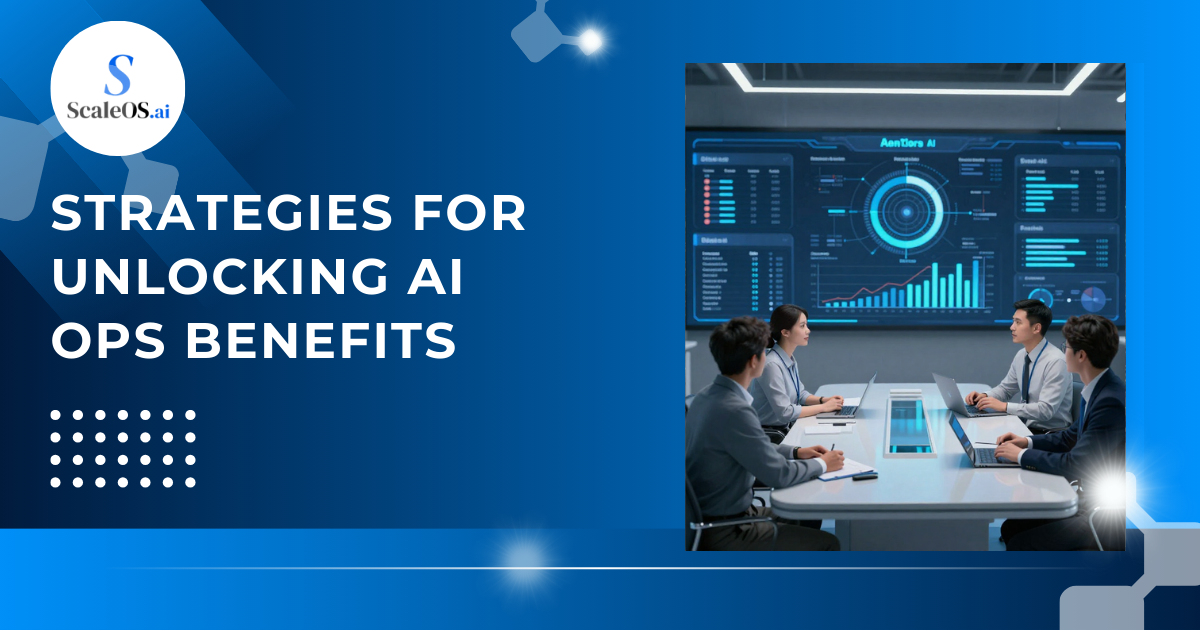
To unlock the full potential of AI operations management, organizations should apply the following strategies together.
Improving Self-Service Capabilities
AI-powered self-service portals and chatbots help users resolve common issues independently. This reduces ticket volume and supports AI support real-time operations monitoring while improving user experience.
Helping Humans to Excel
AI does not replace experts. Instead, it enhances them. AI operations specialists gain access to predictive insights and recommendations, enabling faster and more accurate decisions across IT operations.
Using AI Agents
AI agents are autonomous systems capable of diagnosing and resolving issues without human input. These agents support AI powered operations by acting as first responders and continuously improving system health.
Supercharging Processes
AI enables teams to rethink processes rather than just automate existing ones. By defining safe operating limits, organizations can simplify change management and make operations more proactive using generative AI for IT operation.
Getting Started with AI Ops: Five Steps for Transformation
At FutuCare, we believe AI operations management will fundamentally improve IT operations. Based on our experience delivering AI ops automation services, these five steps can guide successful adoption.
1. Assess the Current State of IT Operations
Evaluate where automation and artificial intelligence in IT operations can create the most value, particularly in repetitive, data-heavy workflows.
2. Identify Problems and Opportunities
Pinpoint operational challenges that could benefit from an AI IT ops solution, such as slow incident response or inefficient monitoring.
3. Secure Quick Wins
Implement small projects first to demonstrate value. Early success builds trust and accelerates organization-wide adoption of AI powered operations.
4. Define Tools, Roles, and Responsibilities
Assign ownership and align teams. Establishing clear roles for AI operations specialists ensures long-term success.
5. Work Iteratively and Measure Progress
AI Ops adoption is continuous. Regular assessment ensures that AI powered business operations evolve alongside organizational needs.
The Future of IT Operations

AI Ops is more than a trend. It represents the future of IT operations. By combining artificial intelligence in IT operations, machine learning, and automation, organizations can build self-healing, self-optimizing systems that reduce downtime and improve decision-making.
Our AI ops automation services are available to existing and new Managed Services clients. We also provide advisory services to help organizations build this capability internally, including specialized support for AI-powered dealership operations and enterprise environments.
FAQs
How do AI-powered operations improve business efficiency?
AI powered operations reduce manual workload, improve response times, and enable predictive decision-making. At FutuCare, clients see improved uptime and lower operational costs through automation and proactive monitoring.
What is an AI IT ops solution?
An AI IT ops solution combines machine learning, automation, and analytics to manage IT systems more intelligently, enabling proactive incident prevention and optimization.
How do businesses implement AI IT ops solutions?
Organizations typically begin by integrating AI into existing monitoring tools, followed by automation workflows and training AI operations specialists. FutuCare supports this journey end-to-end.
What is generative AI for IT operations?
Generative AI for IT operation uses advanced models to analyze data, generate insights, recommend actions, and improve operational decision-making over time.