




13 Best AI Voice Assistants for 2026: Ranked & Reviewed
We are no longer in the era of "set a timer" voice commands. In 2026, the best voice assistant AI has evolved into an autonomous executor. After testing 20+ solutions, the data is clear: businesses integrating AI in digital marketing are seeing a 544% ROI, with voice-first workflows reducing call times by 50%. If you aren't using an AI-based voice assistant to bridge the gap between "asking a question" and "executing a task," you’re leaving hours of productivity on the table.
How I researched and tested these AI voice assistants
To find the best voice assistant AI for this year, I didn't just look at the app store ratings. I put these tools through a rigorous 40-hour stress test across common AI marketing automation scenarios. At ScaleOS, we believe a tool is only as good as the time it saves you, so I evaluated each assistant based on four key "ScaleOS Benchmarks":
Execution vs. Conversation: Does it just talk, or does it actually update your CRM and send emails?
Contextual Intelligence: Does it remember what we discussed five minutes ago, or do I have to start over?
Marketing Integration: How well does it fit into a professional AI marketing agency stack (HubSpot, Salesforce, Slack)?
Latency & Response: In 2026, a 3-second delay is a dealbreaker. We looked for sub-500ms response times.
Custom HTML/CSS/JAVASCRIPT
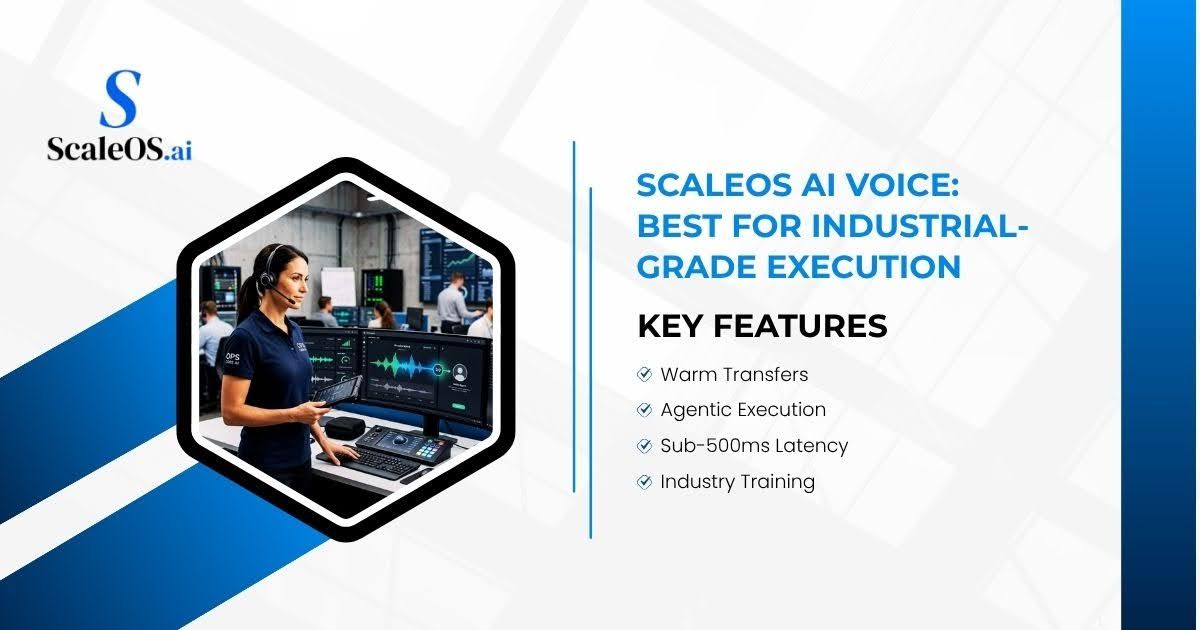
1. ScaleOS AI Voice: Best for Industrial-Grade Execution
What it is: A specialized AI-based virtual assistant engineered for high-stakes business outcomes and autonomous task completion.
Best for: Businesses needing a "digital employee" to qualify leads, book appointments, and manage CRM workflows 24/7.
Key Features
Warm Transfers: Instant routing to humans with live context summaries.
Agentic Execution: Real-time CRM updates and calendar booking during calls.
Sub-500ms Latency: Fluid, human-like response times to maintain trust.
Industry Training: Pre-loaded with sector-specific jargon (Real Estate, Insurance, Auto).
Pros and Cons
Pros: Handles the entire funnel from greeting to booking; 99% data accuracy; automatic SMS follow-ups.
Cons: Professional focus may be overkill for hobbyists; requires 72-hour deep integration for peak performance.
Bottom Line
ScaleOS AI Voice is the leader in AI marketing automation because it focuses on revenue, not just talk. It’s the gold standard for 2026 teams that want to bridge the gap between a voice command and a closed deal.
2. Lindy: Best for Workflow Integration
What it is: A versatile AI-based virtual assistant designed to automate professional "busy work" across your entire software stack without needing a single line of code.
Best for: Founders and operations teams who want an assistant that manages their inbox, schedules meetings, and handles cross-app follow-ups in plain English.
Key Features
Native App Orchestration: Connects seamlessly with 1,000+ tools like Slack, HubSpot, and Gmail to execute multi-step tasks (e.g., "Summarize this Slack thread and email it to the team").
No-Code Agent Builder: A drag-and-drop interface that lets you build custom "Lindies" for specific roles like lead generation or HR screening.
Proactive Notifications: Unlike reactive tools, it can alert you to CRM changes or urgent meeting updates before you even check your dashboard.
Multichannel Voice: Supports voice-to-task commands via phone dictation or Apple Watch, making it a powerful AI-based voice assistant for mobile pros.
Pros and Cons
Pros: Incredible "Human-to-App" interaction; SOC 2 and HIPAA compliant for secure data handling; deep CRM and calendar integration.
Cons: Pricing ($49.99/mo+) is higher for solo users; focuses on work productivity rather than smart home or creative tasks.
Bottom Line
Lindy is the ultimate choice for those who need a "Digital Chief of Staff." While it’s less about industrial sales calls than ScaleOS, it’s the best in class for turning your voice into a fully automated office workflow.
3. ChatGPT Voice: Best for Strategic Nuance
What it is: The gold standard for AI assistant audio response capabilities, offering near-instant, emotionally intelligent conversations that feel like talking to a human partner.
Best for: Founders and marketers who need a brainstorming companion for high-level strategy, creative research, and role-playing complex scenarios.
Key Features
Advanced Voice Mode: Supports fluid, back-and-forth dialogue where you can interrupt mid-sentence or ask the AI to change its tone (e.g., "Sound more professional" or "Explain this like a pirate").
Prism Workspace: A new-for-2026 feature that allows you to transition your voice brainstorms into structured, collaborative drafts in a dedicated writing space.
Multimodal Screen Sharing: On mobile, you can share your live camera or screen so the AI can "see" what you’re looking at and provide real-time verbal guidance.
Deep Reasoning (GPT-5.2): Powered by the latest logic engines, it handles complex, multi-step questions better than any other general-purpose AI-based voice assistant.
Pros and Cons
Pros: Peerless conversation quality and "human" feel; works flawlessly across iOS, Android, and Desktop; accessible entry pricing ($20/mo for Plus).
Cons: Limited "agentic" power (it won't book a real-world meeting for you); usage caps apply even on paid plans during peak 2026 traffic.
Bottom Line
ChatGPT Voice is the best "Thinker" on this list. While it lacks the "Doer" capabilities of ScaleOS or Lindy, it is an unbeatable tool for AI in digital marketing professionals who need to talk through a problem to find a solution.
4. Retell AI: Best for Outbound Scaling
What it is: A developer-first voice-enabled product search platform and outbound engine designed for ultra-low latency and programmatic call management.
Best for: AI marketing agencies and technical teams building high-volume cold outreach or automated lead qualification funnels.
Key Features
Interruption Handling (Barge-in): One of the most human-like systems in 2026; the AI instantly stops talking when a prospect interrupts, allowing for a natural conversational flow.
LLM Flexibility: Unlike closed systems, Retell allows you to swap between models (GPT-4o, Claude 3.5, or custom LLMs) to balance cost and response quality.
Developer-First API: Built for technical teams to trigger "Warm Transfers" to human reps or deep CRM lookups via custom webhooks.
Global Telephony (BYOC): Bring Your Own Carrier support allows you to integrate with Twilio or Vonage while using Retell’s low-latency "brain."
Pros and Cons
Pros: Sub-600ms latency ensures no "robotic" pauses; highly scalable for thousands of concurrent calls; SOC 2 and HIPAA compliant.
Cons: Requires developer resources for setup (no visual drag-and-drop builder); usage-based pricing can be unpredictable for massive campaigns.
Bottom Line
Retell AI is the "Infrastructure King" of 2026. If you have the technical talent and need to run 10,000+ outbound calls a month with near-zero delay, Retell is the engine that will power your AI marketing automation.
5. Google Gemini: Best for the Google Workspace Power User
What it is: A deeply integrated AI-based virtual assistant that leverages Google’s 2026 "Personal Intelligence" to navigate your Gmail, Drive, and Docs via natural voice.
Best for: Professionals whose daily lives revolve around Google Workspace and Android, requiring an assistant that "knows" their files and schedule.
Key Features
Native Workspace Integration: Use voice commands like "Summarize the feedback from yesterday’s Docs" or "Find the flight info in my Gmail," and Gemini pulls the data instantly.
Gemini Live (Multi-Turn): A high-speed conversational mode that allows you to interrupt, pivot topics, or brainstorm out loud while walking or driving.
Massive Context Window: Capable of processing up to 2 million tokens, meaning you can "voice-search" through thousands of emails or massive PDFs in seconds.
Deep Research Mode: An agentic feature that autonomously browses the live web to compile cited reports, which can then be voice-summarized for you on the go.
Pros and Cons
Pros: Best-in-class integration with Google apps; excellent real-time web grounding via Google Search; 5 TB of pooled storage on top tiers.
Cons: Advanced features like "Ultra" reasoning require a $40+/mo subscription; third-party app integration (outside Google) is still catching up to Lindy.
Bottom Line
Google Gemini is the ultimate "Knowledge Assistant" for 2026. If your business runs on Google, this is the most seamless AI in digital marketing tool for keeping your data accessible and your hands free.
6. Siri (Apple Intelligence): Best for Apple Ecosystem Users
What it is: Apple’s reimagined personal assistant, which, in 2026, has been rebuilt from the ground up using Google’s Gemini models to handle complex reasoning while maintaining Apple’s strict privacy standards.
Best for: Individuals fully immersed in the Apple hardware ecosystem (iPhone, Mac, Apple Watch) who need a privacy-first assistant that understands their personal context across all apps.
Key Features
On-Screen Awareness: Siri can now "see" what is on your screen. You can say "Add this address to my contact for John" while looking at a text message, and it executes the task instantly.
Personal Context Engine: Powered by "Private Cloud Compute," Siri can cross-reference your Mail, Messages, and Calendar. Ask "When does my mom's flight land?" and it pulls the answer without your data ever being stored by Apple or Google.
Cross-App Actions: One of the biggest 2026 upgrades; Siri can now chain commands across apps, such as "Edit this photo and send it to the group chat I was just in."
Dynamic Island "Campo" Interface: A new glowing visual redesign that expands into a standalone chatbot-style app for long-form brainstorming or persistent chat history.
Pros and Cons
Pros: Unmatched privacy and on-device processing; seamless "magical" integration with Apple hardware; access to ChatGPT for world-knowledge queries.
Cons: Most advanced features are limited to iPhone 15 Pro and newer; 2026 features are rolling out in a "phased preview" that can feel half-baked compared to dedicated agents.
Bottom Line
Siri has finally grown up in 2026. While it still focuses more on personal assistance than industrial AI marketing automation, its deep integration makes it the most convenient "hands-free" tool for the everyday Apple professional.
7. Otter.ai: Best for Meeting Intelligence & Sales Memory
What it is: A specialized AI assistant audio response tool that lives in your calendar, automatically joins your video calls, and converts spoken dialogue into searchable, actionable data.
Best for: Sales teams, journalists, and project managers who need "perfect memory" of every Zoom, Teams, or Google Meet call without the distraction of manual note-taking.
Key Features
OtterPilot: An autonomous bot that joins your scheduled meetings, captures real-time slides/screenshares, and generates an automated summary before the call even ends.
Otter AI Chat: A 2026 standout feature that allows you to "ask" your meeting questions like "What was the specific budget John mentioned?" or "Draft a follow-up email based on our next steps."
Multi-Meeting Intelligence: Capable of searching across your entire history of recorded calls to find patterns, recurring themes, or specific decisions made months ago.
Direct CRM Sync: On Business and Enterprise tiers, Otter automatically pushes meeting summaries and identified "Action Items" into Salesforce or HubSpot.
Pros and Cons
Pros: Peerless at speaker identification and "diarization"; extremely reliable automated calendar integration; affordable entry-level pricing for individuals.
Cons: Language support is currently limited to English, French, and Spanish; accuracy can dip significantly in noisy environments or with heavy accents.
Bottom Line
Otter.ai is the "Administrative Memory" every modern team needs. While it lacks the proactive outbound power of ScaleOS, it is the best tool on the market for ensuring that what happens in a meeting doesn't stay in the meeting, but actually gets documented and executed.
8. Bland AI: Best for Enterprise-Level Custom Voice Agents
What it is: A hyper-scalable voice-enabled product search platform and development engine designed to handle millions of phone calls with human-like intelligence and zero latency.
Best for: Large-scale enterprises and AI marketing agencies that need to build complex, multi-layered phone funnels for customer support, cold calling, or appointment setting.
Key Features
Hyper-Realistic Latency: Engineered for conversation, Bland AI achieves response speeds that make it nearly impossible to distinguish from a human on the other end of the line.
Custom Tool-Calling: In 2026, Bland allows agents to "call tools" mid-conversation, meaning they can check real-time stock prices, look up a customer's loyalty points, or calculate a mortgage rate live on the call.
Granular Voice Tuning: Unlike general assistants, you can adjust the "vibe," speed, and emotional tone of the voice to match your brand’s specific identity.
Advanced "Wait-Time" Handling: If the AI needs to process data, it uses "filler words" (like "Let me see..." or "One second...") to keep the human engaged naturally.
Pros and Cons
Pros: Built for massive scale (capable of thousands of simultaneous calls); highly flexible API for custom integrations; superior at handling aggressive or complex prospect interactions.
Cons: High technical barrier to entry (requires developer knowledge); strictly focused on phone calls, not useful for desktop productivity or meeting notes.
Bottom Line
Bland AI is the "Brute Force" of 2026. If you need a fleet of 100 virtual cold-callers that can handle the nuance of a high-pressure sales floor, Bland is the infrastructure that will power your AI marketing automation.
8. Alexa+: Best for Proactive Smart Home Orchestration
What it is: Amazon’s total rebuild of its voice assistant, now powered by generative AI (and Anthropic’s Claude), shifting from a simple command-response box to an autonomous "Home Agent."
Best for: Families and smart-home enthusiasts who want a proactive assistant that manages household logistics, security, and meal planning end-to-end.
Key Features
Agentic Task Completion: Alexa+ can now navigate the web to finish chores. You can say, "Find a plumber to fix the oven," and it uses services like Thumbtack to book the appointment and add it to your calendar.
Proactive "Omnisense" Awareness: It doesn't wait for you to speak. It can alert you to unusual Ring camera patterns, notify you when a "watched" item goes on sale, or suggest leaving early for a commute due to live traffic.
Smart Kitchen Manager: Remembers the dietary restrictions of every family member. It can suggest recipes based on what's in your fridge and automatically add missing ingredients to your Whole Foods cart.
Conversational Multi-Turn: No more repeating "Alexa" for every follow-up. You can have a fluid, back-and-forth discussion, and even interrupt her mid-sentence to pivot the task.
Pros and Cons
Pros: Included free for 180M Prime members; the undisputed king of smart home control (97% device compatibility); handles real-world logistics (reservations/shopping) better than Siri.
Cons: Standalone price for non-Prime members is $19.99/mo; requires sharing deep access to emails and documents for "agentic" features to work effectively.
Bottom Line
Alexa+ is the gold standard for AI-based voice assistants in the domestic sphere. While ScaleOS dominates the business office, Alexa+ is the 2026 winner for managing the "business of the home."
9. Pi (Inflection AI): Best for Empathetic Brainstorming
What it is: A uniquely "emotional" AI-based virtual assistant designed to be a supportive conversationalist rather than a rigid task manager. In 2026, Pi has leaned further into its role as a digital companion that remembers your personal goals and communication style.
Best for: Founders and creators who need a non-judgmental sounding board for exploring complex ideas, venting about "Admin Hell," or practicing difficult conversations.
Key Features
Emotional Intelligence (EQ): Pi is programmed to be kind, curious, and supportive. It asks follow-up questions about how you feel about a project, not just what the deadline is.
Natural Voice Flow: Its voice mode is incredibly lifelike, featuring subtle human-like pauses and "active listening" cues that make long discussions feel natural.
Goal Tracking: Unlike generic bots, Pi can track your long-term personal objectives, checking in on your progress with a supportive, coaching-style tone.
Discovery Feed: A personalized content stream that suggests articles and topics based on your previous voice discussions, helping you "fuel your curiosity" daily.
Pros and Cons
Pros: Completely free to use with no hidden tiers; the best tool on this list for mental clarity and stress reduction; highly personalized memory.
Cons: Not built for AI marketing automation or app execution; it won't book your meetings or update your CRM like ScaleOS or Lindy.
Bottom Line
Pi is the "Therapist-meets-Coach" of the AI world. While it won't run your business, it will ensure you have the mental clarity to run it yourself. It’s an essential tool for any entrepreneur’s mental health toolkit in 2026.
10. Rabbit R2: Best for Dedicated Voice Hardware
What it is: The 2026 successor to the R1, the Rabbit R2 is a standalone pocket device that uses a "Large Action Model" (LAM) to navigate your apps for you via voice, eliminating the need to pull out your phone.
Best for: Mobile professionals and tech enthusiasts who want a "distraction-free" device that prioritizes voice-first execution over screen-time.
Key Features
LAM 2.0 (Action Model): The R2 can navigate complex app interfaces (Uber, DoorDash, Expedia) purely through voice prompts, handling multi-step bookings without you touching a screen.
360-degree Rotating Camera: Uses "vision-to-voice" to identify objects or read documents in the physical world and provide instant verbal analysis or translation.
Global Connectivity: Comes with built-in 5G and an eSim, allowing it to function as a standalone pocket assistant anywhere in the world.
Low-Latency Processing: The 2026 hardware is 300% faster than the original R1, making the voice-to-action loop feel nearly instantaneous.
Pros and Cons
Pros: Specialized hardware removes smartphone distractions; powerful "vision" capabilities; affordable one-time purchase ($199) with no mandatory subscription.
Cons: Ecosystem is still growing, some apps aren't fully supported; requires carrying a second device in your pocket.
Bottom Line
The Rabbit R2 is the future of "Screenless" productivity. While ScaleOS handles your office desk, the R2 is your best friend for managing life on the move without getting sucked into your phone's notification black hole.
11. ElevenReader: Best for High-Fidelity Audio Content
What it is: A specialized AI assistant audio response platform from the leaders at ElevenLabs, designed to turn static text (articles, PDFs, and newsletters) into ultra-realistic, expressive narrated audio.
Best for: Content consumers and professionals who want to listen to complex reports or scripts on the go without the "robotic drone" of traditional text-to-speech.
Key Features
Emotional Depth Tuning: Unlike standard assistants, ElevenReader allows you to choose voices with specific "personalities", from authoritative and news-focused to calm and storytelling-oriented.
Instant Voice Cloning: In 2026, you can clone your own voice or a teammate’s in seconds to "read" your documents back to you, maintaining brand consistency across internal communications.
Speech-to-Speech (S2S): A standout feature that lets you record a rough vocal take and have the AI "re-skin" it into a professional voiceover while keeping your original pacing and emotion.
Multilingual Dubbing: Supports 29+ languages while preserving the speaker’s original vocal profile, making it a top tool for global AI in digital marketing teams.
Pros and Cons
Pros: Highest audio quality in the industry; incredibly expressive and human-like delivery; powerful API for developers.
Cons: High credit usage can get expensive for long-form books; focus is strictly on audio generation, it won't manage your calendar or tasks.
Bottom Line
ElevenReader is the gold standard for "Listening." While it isn't an execution agent like ScaleOS, it is the best tool for turning your reading list into a high-end personal podcast, saving your eyes from screen fatigue.
12. Speechify: Best Overall Voice AI Productivity Tool
What it is: A comprehensive "Voice-First" workspace that has evolved from a simple screen reader into a full-scale AI-based virtual assistant that manages reading, writing, and dictation.
Best for: Students, researchers, and ADHD professionals who need a multi-tool to help them digest information faster and draft content using only their voice.
Key Features
Full-Stack Productivity: As of 2026, it includes "Voice Typing" (dictation), an AI Meeting Assistant, and an "AI Podcast" generator that turns any URL into a multi-speaker audio summary.
Celebrity Voice Library: Still a fan favorite, allowing you to have Snoop Dogg, Gwyneth Paltrow, or top-tier professional narrators read your emails and documents.
Scan-to-Speech: Use your mobile camera to scan a physical document or book, and Speechify instantly converts it into a high-quality audio file.
Unified AI Workspace: A central hub that syncs your transcripts, voice notes, and audio files across Mac, iOS, and Android.
Pros and Cons
Pros: Exceptionally polished user interface; covers the entire productivity loop (read, write, summarize); includes high-speed reading modes (up to 900 WPM).
Cons: The subscription cost ($139/year) is a significant commitment; newer meeting features aren't as deep as specialized tools like Otter or Fireflies.
Bottom Line
Speechify is the "Swiss Army Knife" of 2026 voice tech. It’s perfect for the person who wants one app to handle their reading, meeting notes, and dictation in one beautifully designed ecosystem.
13. Fireflies.ai: Best for Collaboration & CRM Intelligence
What it is: A specialized AI marketing automation tool for meetings that focuses on "Conversation Intelligence," turning spoken sales calls into structured data.
Best for: AI marketing agencies and sales teams who need to extract deep insights, sentiment analysis, and automated CRM entries from every client interaction.
Key Features
"AskFred" Assistant: A 2026 conversational bot that lives inside your meeting history. You can ask Fred, "What were the three biggest objections in last month's calls?" and get a cited report.
Deep CRM Orchestration: Automatically logs call snippets, summaries, and action items directly into HubSpot, Salesforce, or Pipedrive.
Topic Tracking & Sentiment: Visually graphs the "vibe" of a call, telling you when the prospect was most engaged or where they felt confused.
Soundbites & Playlists: Allows you to "clip" a 30-second quote from a meeting and share it instantly to a Slack channel or a client-facing portal.
Pros and Cons
Pros: Massive storage (800+ mins on free tier); excellent integration with 6000+ apps via Zapier; specialized "Sales Coaching" modules.
Cons: Interface can feel cluttered with too many "pro" features; no video recording on lower tiers.
Bottom Line
Fireflies.ai is the ultimate tool for "Data-Driven Teams." If you want your meetings to be a searchable database that automatically fuels your sales funnel, Fireflies is the bridge between a conversation and a closed deal.
The "Agentic" Shift: Why 2026 is Different
We are moving from voice assist (helping you) to voice execution (doing it for you).
Hyper-Personalization: By 2026, 60% of marketers are investing in voice search optimization.
Revenue Uplift: Companies using top AI assistants report a 10%+ revenue boost within 6 months due to faster lead qualification and 24/7 responsiveness.
How to choose the right AI assistant for your brand
Choosing the best voice assistant AI depends on your specific "Admin Hell."
Choose ScaleOS if you need an industry-specific agent that books appointments and closes sales 24/7.
Choose ChatGPT if you need a brainstorming partner for AI in digital marketing.
Choose Retell or Bland AI if you are building a custom outbound funnel for your agency.
The ScaleOS Verdict: From "Voice Assist" to "Voice Profit"
In 2026, the winners aren't the ones with the most tools, but the ones with the most integrated "pipes." At ScaleOS, we don't just recommend these tools, we help you orchestrate them. Whether you are using AI marketing automation to handle your leads or chatbots voice assistants to manage support, the goal is to get you out of the weeds and back into the driver's seat.
Stop talking to your tech and start making your tech work for you.
Are You Ready to Automate Your Voice Workflow? Let’s Build Your Engine Together With ScaleOS Austin
About the Author:
This guide was researched and developed by the ScaleOS Insights Team, a specialized group of automation architects and workflow engineers dedicated to the science of Agentic Orchestration.
Frequently Asked Questions
How to rank in voice assistants?
To rank in voice assistants, use natural language and question-based H3 headings. Provide direct, 40-word answers at the top of sections, utilize Schema markup, and ensure your site loads sub-500ms for mobile-first indexing.
Which AI assistant is the best?
The best AI assistant depends on your needs: ChatGPT Plus is the top general-purpose choice, ScaleOS leads for business execution, and Google Gemini is the premier option for Google Workspace power users in 2026.
What is the best AI assistant?
ScaleOS is currently the best AI assistant for business growth and autonomous task execution. It outperforms competitors by integrating directly into CRMs and calendars to book appointments and qualify leads without human intervention.
What is a conversational AI voice assistant?
A conversational AI voice assistant uses natural language processing (NLP) to simulate human-like dialogue. Unlike basic bots, they understand intent, handle interruptions, and can execute complex tasks like scheduling or sales transfers in real-time.